

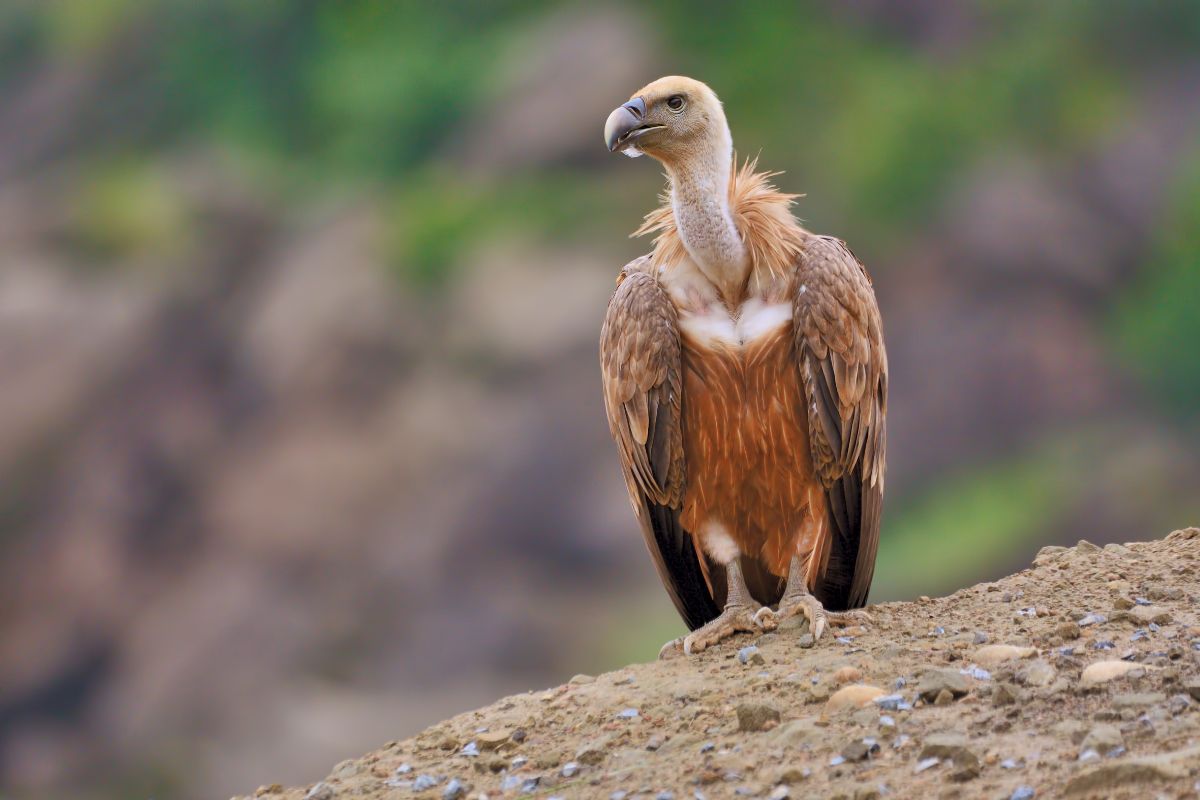
Vultures have disappeared from nearly 72 percent of their known nesting sites across India, according to a new national assessment by the Wildlife Institute of India (WII). The study warns that the country’s vulture populations remain fragile despite some stabilization in recent years.
The report, titled Pan India Assessment and Monitoring of Endangered Species, Vultures, is the first nationwide effort to map and assess the nesting patterns of India’s four Critically Endangered vulture species. These include the White-rumped Vulture (Gyps bengalensis), Indian Vulture (Gyps indicus), Slender-billed Vulture (Gyps tenuirostris), and Red-headed Vulture (Sarcogyps calvus).
India’s Vultures Are Vanishing
Researchers documented 425 historical nesting sites across 25 states using past records. During fieldwork from February 2023 to January 2025, they found active nesting in only 120 of these sites. Another 93 new nesting sites were identified, bringing the total to 213. Of these, 103 are within protected areas such as wildlife sanctuaries and national parks.
Lead author of the study, Dr. R. Suresh Kumar, said, “This forms a crucial baseline as to just how many nests of each vulture species currently exist across their range in India, and most importantly, where these sites are. It underscores the urgent need for targeted conservation interventions.”
The assessment found that Madhya Pradesh and Rajasthan together hold about 63 percent of all vulture nests in India. Over 60 percent of these are located within protected areas. Scientists say these two states now serve as strongholds for remaining populations because of their suitable habitats and reduced human disturbance.
The White-rumped Vulture, once the most widespread species in India, has suffered a sharp contraction in range. It was recorded at only 69 locations during the survey, down from 238 historically known sites. Thirty-nine of the current sites are newly discovered. This means the species now occupies only about 13 percent of its former nesting areas.
The Indian Vulture, which was found nesting at 110 sites, retained 86 historical locations while adding 24 new ones. It remains the most widely distributed species but is now largely restricted to central India. It has disappeared from nearly 30 percent of its earlier known sites.
Nesting Grounds Nearly Wiped Out
The Slender-billed Vulture has suffered the steepest decline. The study found no nesting activity at any of its 47 historical sites. The species is now limited to 12 new sites in Upper Assam, with only 20 active nests. Scientists attribute this loss to deforestation, shrinking floodplain forests, and a lack of tall trees suitable for nesting.
“The Slender-billed Vulture’s breeding population is now entirely restricted to Upper Assam,” the report said. “This marks the only remaining known breeding population in the country.”
The Red-headed Vulture was found nesting at five newly identified sites in Madhya Pradesh and Rajasthan, while the Himalayan Griffon was recorded at eight sites, including four historical ones. Migratory species like the Egyptian Vulture and Eurasian Griffon were observed more frequently at carcass dumps, often outnumbering resident species.
Researchers also examined carcass dumping sites across nine states. They found that Indian and White-rumped Vultures were largely absent from these areas, while feral dogs dominated. The increase in dog populations poses a growing threat to scavenging birds.
“There is an urgent need to integrate carcass management into conservation planning,” the report said. It recommended ensuring carcasses are free of toxic veterinary drugs such as diclofenac, controlling feral dogs at feeding sites, and routinely monitoring vulture use of these areas.
India’s Vultures Still Struggle to Recover
Dr. Kumar said the findings would help guide recovery efforts. “This study provides the most accurate picture yet of where India’s remaining breeding populations exist. Protected areas have become the last safe spaces for these species,” he said.
The White-rumped Vulture population is now concentrated mainly in Himachal Pradesh’s Kangra Valley, which accounts for nearly two-thirds of all nests of the species nationwide. In contrast, the Slender-billed Vulture, once common across the Gangetic plains and Brahmaputra valley, is now confined to a small part of Upper Assam.
The WII report concludes that while India’s vulture populations have stopped declining at the rate seen during the early 2000s, recovery remains slow and uncertain. The birds continue to face threats from toxic drugs, habitat loss, and reduced food access.
The findings are part of the National Vulture Database, which will serve as a long-term monitoring tool for population trends and breeding success. The scientists warn that without sustained protection and habitat restoration, many historical nesting sites may never recover their lost colonies.
Support us to keep independent environmental journalism alive in India.
Keep Reading
Elephants Are Back in MP After a Century, But Can They Stay?
Solar Energy – A Paradigm Shift in Wildlife Conservation
Stay connected with Ground Report for underreported environmental stories.