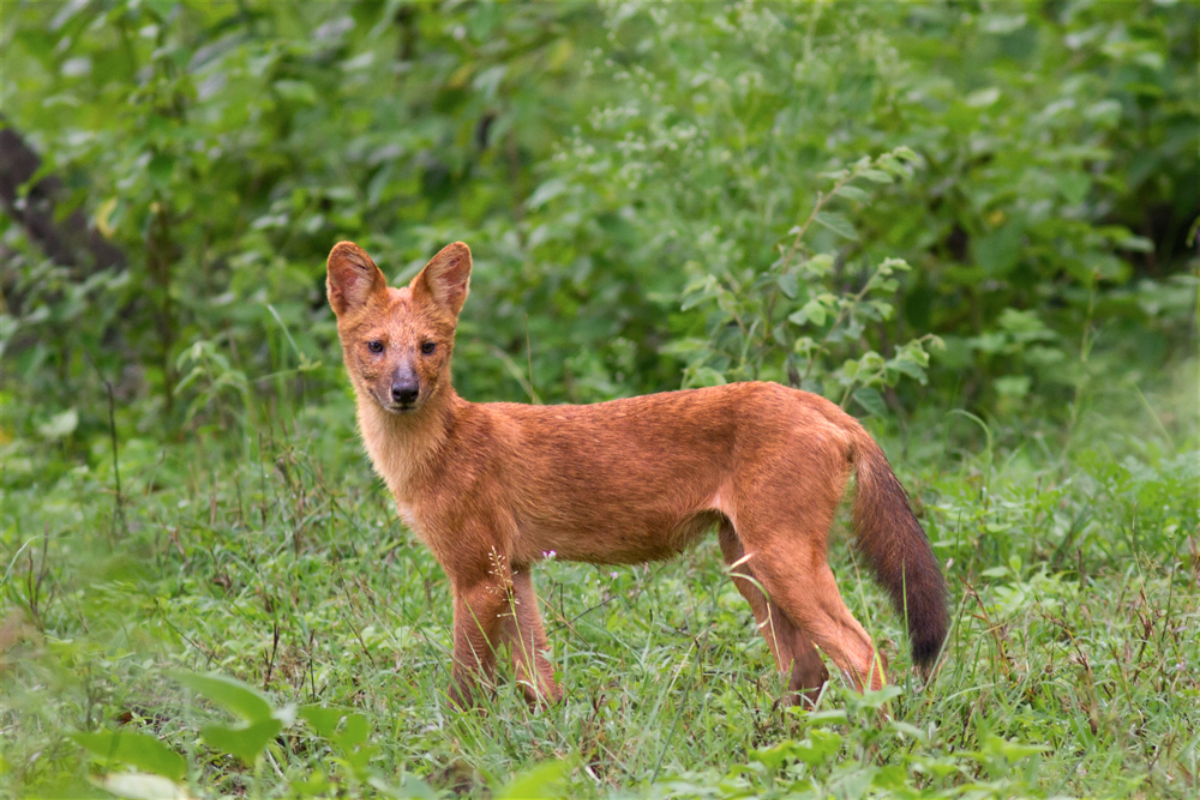
A rare pack of wild dogs, also known as dholes or Son dogs, has been spotted again in Bandhavgarh Tiger Reserve after nearly two years. Forest staff confirmed sightings of over 20 wild dogs moving in two groups across the Panpatha beat of the Pataur range in Umaria district.
These animals are among the least seen predators in India’s forests. The International Union for Conservation of Nature (IUCN) lists them as endangered, with fewer than 2,500 left in the wild. Once common across Asia, dholes have now vanished from most of their former range.
“These dogs have been seen again after two years,” said Arpit Mairal, a ranger at the reserve. “They don’t stay in one place and are always on the move, which makes them hard to track.”
Known for their group hunting style and strong social structure, dholes live in packs of 5 to 12 members, though larger groups are also common. They share food, raise pups together, and protect each other. Their coordination allows them to take down prey much larger than themselves.
“Son dogs hunt in groups and don’t wait for the prey to die,” said PK Verma, Deputy Director of the tiger reserve. “As soon as it falls, even if still alive, the whole pack starts feeding. They are fast, aggressive hunters.”
An adult wild dog stands about 2 to 2.5 feet tall and can reach 3 feet in body length, not counting the tail. They have reddish-brown fur, a black tail, and a fox-like face. Some people confuse them with red foxes or even stray dogs, but they are a completely different species.
The dhole, also known as the Asiatic Wild Dog (Cuon alpinus), is found in three main regions across India: the Western and Eastern Ghats, Central India, and Northeast India.
Unlike other dogs, dholes don’t bark. They whistle and use high-pitched calls to stay in touch during hunts or when moving through dense forests. These calls echo through the jungle, which has earned them the nickname “whistling dogs.”
Their hunting method is fast, loud, and deadly. Even large predators like tigers avoid packs of wild dogs. Forest officials say that when wild dogs are around, tigers often shift their territory to stay out of their way.
Dholes roam constantly. They don’t stick to one area and move deep into the jungle, which makes them hard to track. Camera traps, pugmarks, and direct sightings are the only ways officials can monitor them.
Verma said tigers often avoid areas where dholes move in packs. “They can smell tiger cubs from far away and sometimes even eat them. Tigers shift their territory when these dogs are around.”
The dholes were last spotted in Bandhavgarh in 2023. Around eight months ago, pups were seen in the Manpur forest range. Now, their confirmed return has prompted forest officials to notify the Wildlife Institute of India (WII). Due to their fast movement and remote forest routes, officials cannot track them using GPS. Instead, they rely on camera traps, direct sightings, and pugmarks.
In February 2025, the Phase-4 tiger census revealed two dhole packs in Bandhavgarh. Verma said the total count may exceed 20 individuals. “We are now monitoring them closely. Their return shows the forest is in good health,” he said.
Dr. YB Jhala, a senior scientist with the WII, said wild dogs once roamed from Kashmir to Bihar. “Since 1990, they’ve been marked as locally extinct in several areas,” he said. “Seeing them again in Bandhavgarh is significant.”
Wild dogs have also been spotted in Pench and Kanha reserves, but in smaller numbers. Their presence in Bandhavgarh suggests that the forest still provides a safe environment for one of India’s rarest and most elusive carnivores.
Support us to keep independent environmental journalism alive in India.
Keep Reading
Short circuits, long suffering: MP’s farm fire tragedies
Sun-kissed farmers: Promises and problems of MP’s solar pumps
How a hydro project in shahabad forest threatens india’s Cheetah Corridor
Scorching Schools: MP’s poor infrastructure puts kids at risk in heatwaves
Follow Ground Report on X, Instagram and Facebook for environmental and underreported stories from the margins. Give us feedback on our email id greport2018@gmail.com.
Don’t forget to Subscribe to our weekly newsletter, Join our community on WhatsApp, and Follow our YouTube Channel for video stories.