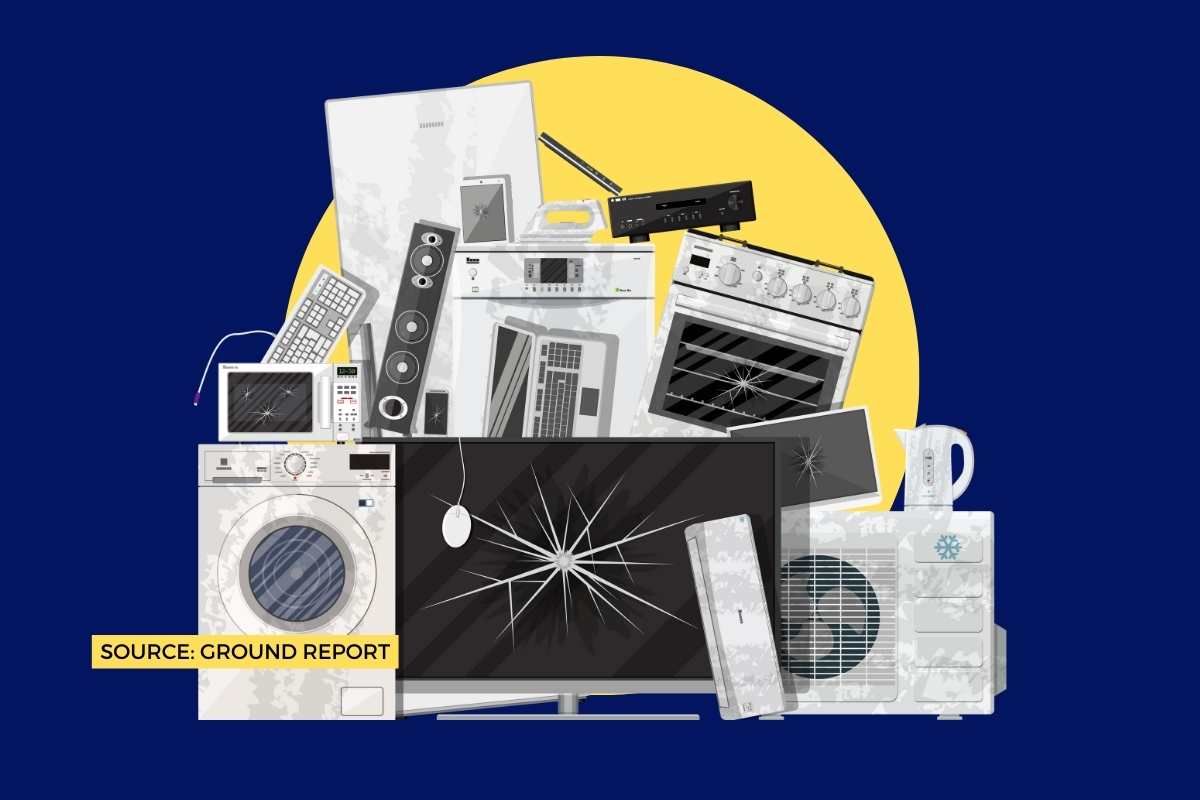
Electronic waste or Waste Electrical and Electronic Equipment (WEEE) is defined under the Basel Convention as, ‘Electrical or electronic equipment that is waste, including all components, sub-assemblies and consumables that are part of the equipment at the time the equipment becomes waste.’
Under the Basel Convention, e-waste can be categorised as hazardous or non-hazardous waste. It is hazardous when it has toxic materials such as mercury, lead, or brominated flame retardants.
E-waste and E-waste (Management) Rules
E-waste (Management) Rules 2016, amended in 2018, provides the framework and guidelines for the proper collection, segregation, disposal, and recycling of electrical equipment. The amendment revised the Extended Producer Responsibility. Additionally, it aims to collect 70% of e-waste that is generated as indicated in Extended Producer Responsibility.
Extended Producer Responsibility is the responsibility of every producer of electrical and electronic equipment for channelization of e-waste to an authorized dismantler/ recycler to ensure environmentally sound management of such waste.
Year-wise E-waste Generation in India
According to the Ministry of Environment, Forest and Climate Change’s response to a Rajya Sabha question in December 2025, India’s e-waste scenario shows both challenges and progress. The Central Pollution Control Board (CPCB) estimates e-waste generation based on sales data from registered producers and the average life of electrical and electronic equipment.
| Financial Year | E-Waste Generated (MT) | E-Waste Recycled (MT) | Recycling Rate (%) |
|---|---|---|---|
| 2020-21 | 13,46,496 | 3,54,541 | 26.3% |
| 2021-22 | 16,01,155 | 5,27,132 | 32.9% |
| 2022-23 | 16,09,117 | 5,39,256 | 33.5% |
| 2023-24 | 12,54,287 | 7,78,205 | 62.0% |
| 2024-25 | 13,97,956 | 11,59,228 | 82.9% |
According to the Annual report 2020-2021 by CPCB, 2,22,436 tonnes of e-waste was recycled and dismantled out of the total 10,14,961 tonnes of e-waste that was generated in the year 2020. This means that 21% of the total e-waste was collected and recycled. There are around 2,759 e-waste collection centers of EPR-authorized producers in the country for collection of waste but most of them are not implementing their full capacity.
According to a report published in the Journal of Health and Pollution, Mumbai, Delhi, and Bangalore are the top three e-waste generators. Approximately 95% of generated e-waste is managed by the unorganized sector and scrap dealers. In addition, they dismantle the discarded products instead of recycling them. In India, about 400,000 to 500,000 child laborers between 10-15 years of age are involved in various e-waste activities, the report also stated.
State/UT-wise E-waste Processing
| State/UT | FY 2020-21 | FY 2021-22 | FY 2022-23 | FY 2023-24 | FY 2024-25 |
|---|---|---|---|---|---|
| Andhra Pradesh | 229.10 | 2021.19 | 1302.34 | 776.87 | 209.76 |
| Arunachal Pradesh | – | – | – | – | – |
| Assam | 63.20 | 67.00 | 39.07 | – | – |
| Andaman & Nicobar Islands | 2.03 | 0.78 | – | – | – |
| Bihar | 86.00 | 41.07 | – | – | 6.00 |
| Chhattisgarh | 258.10 | 4167.90 | 133.16 | 7370.84 | 3704.13 |
| Chandigarh | 30.87 | 67.92 | 72.00 | – | – |
| Delhi | 610.13 | 2130.79 | 7.06 | – | – |
| DNH & DD | 586.10 | 12.34 | – | – | – |
| Goa | – | – | 499.20 | – | – |
| Gujarat | 109463.80 | 30569.32 | 62386.24 | 95838.50 | 81424.65 |
| Haryana | – | 245015.82 | 47929.00 | 110431.40 | 161037.76 |
| Himachal Pradesh | 72.94 | 373.20 | 2106.12 | 159.68 | 558.75 |
| Jammu & Kashmir | 150.56 | 561.61 | 186.36 | – | – |
| Jharkhand | 95.31 | 366.71 | 1236.03 | – | 353.02 |
| Karnataka | 96192.45 | 39150.63 | 59821.20 | 21050.10 | 21295.76 |
| Kerala | 1494.00 | 1249.61 | 471.55 | 5242.86 | 10079.63 |
| Ladakh | – | – | – | – | – |
| Lakshadweep | – | – | – | – | – |
| Madhya Pradesh | 419.44 | 553.59 | 3461.52 | 5914.66 | 14990.81 |
| Maharashtra | 14546.00 | 18559.30 | 26710.00 | 40748.63 | 75236.26 |
| Manipur | – | – | – | – | – |
| Mizoram | 19.30 | 14.85 | 18.68 | – | – |
| Meghalaya | 6.17 | – | – | – | – |
| Nagaland | 423.00 | – | – | – | – |
| Odisha | 398.48 | 477.54 | 220.00 | – | – |
| Punjab | 384.30 | 28375.27 | 5952.00 | 65.49 | 3146.84 |
| Puducherry | – | 31.77 | – | – | – |
| Rajasthan | 18742.12 | 27998.77 | 31697.30 | 24399.38 | 22200.11 |
| Sikkim | 35.60 | 8.47 | – | – | – |
| Tamil Nadu | 28305.89 | 31143.21 | 35153.36 | 23203.64 | 17205.83 |
| Telangana | 38346.00 | 42297.68 | 74340.00 | 65226.78 | 132365.25 |
| Tripura | 12.78 | 13.67 | – | – | – |
| Uttar Pradesh | – | – | 127388.90 | 237218.90 | 474777.54 |
| Uttarakhand | 43150.08 | 51541.12 | 57308.91 | 134255.11 | 134708.07 |
| West Bengal | 416.89 | 320.44 | 816.00 | 6302.32 | 5928.07 |
| Total | 354540.65 | 527131.57 | 539256.00 | 778205.16 | 1159228.24 |
Regulatory Framework and Enforcement
The E-Waste (Management) Rules, 2022, introduced a comprehensive revision to strengthen Extended Producer Responsibility (EPR). Key features include:
Registration Portal: All manufacturers, producers, refurbishers, and recyclers must register on the CPCB-developed portal
Third-Party Audits: CPCB has empaneled 15 third-party auditors and developed an audit module with mobile app and web application
Standard Operating Procedures: Clear guidelines for auditor empanelment and compliance verification
Random Inspections: State Pollution Control Boards conduct periodic audits and random inspections
The government has recognized the critical issue you mentioned about 95% of e-waste being managed by the unorganized sector. To address this, the Ministry of Electronics and Information Technology (MeitY) has initiated a project on “Informal Sector Capacity Building Upgradation with formation of recycling clusters under MSME scheme.” This aims to:
Integrate informal-sector workers into formal recycling chains
Create recycling clusters under MSME schemes
Provide safety safeguards for communities exposed to e-waste hazards
Conduct industrial skill development for workers in dismantling and recycling
Under Rule 10(2) of the 2022 Rules, State/UT governments are responsible for ensuring worker safety, health monitoring, and skill development for those involved in e-waste dismantling and recycling.
Conclusion
“With growing technology, e-waste generation is expected to increase. However, recent data shows promising progress, India’s e-waste recycling rate has improved from 26% in 2020-21 to 83% in 2024-25. Yet significant challenges remain: geographic disparities in processing capacity (with states like Uttar Pradesh, Haryana, and Uttarakhand dominating), the need to fully integrate the informal sector responsible for 95% of current e-waste handling, and protecting child laborers (estimated 400,000-500,000 aged 10-15) involved in hazardous e-waste activities.
The path forward requires coordinated efforts: stronger enforcement of EPR obligations, expansion of formal recycling infrastructure across all states, meaningful integration of informal workers with safety protections, and consumer awareness about repair, reuse, and responsible disposal. Only through such comprehensive action can India transform its e-waste challenge into a circular economy opportunity.”
Support us to keep independent environmental journalism alive in India.
Keep Reading
Small Wild Cats in Big Trouble: India’s First National Report Released
After Tragedy, Families Face Delays in Tiger Attack Compensation
Stay connected with Ground Report for underreported environmental stories.