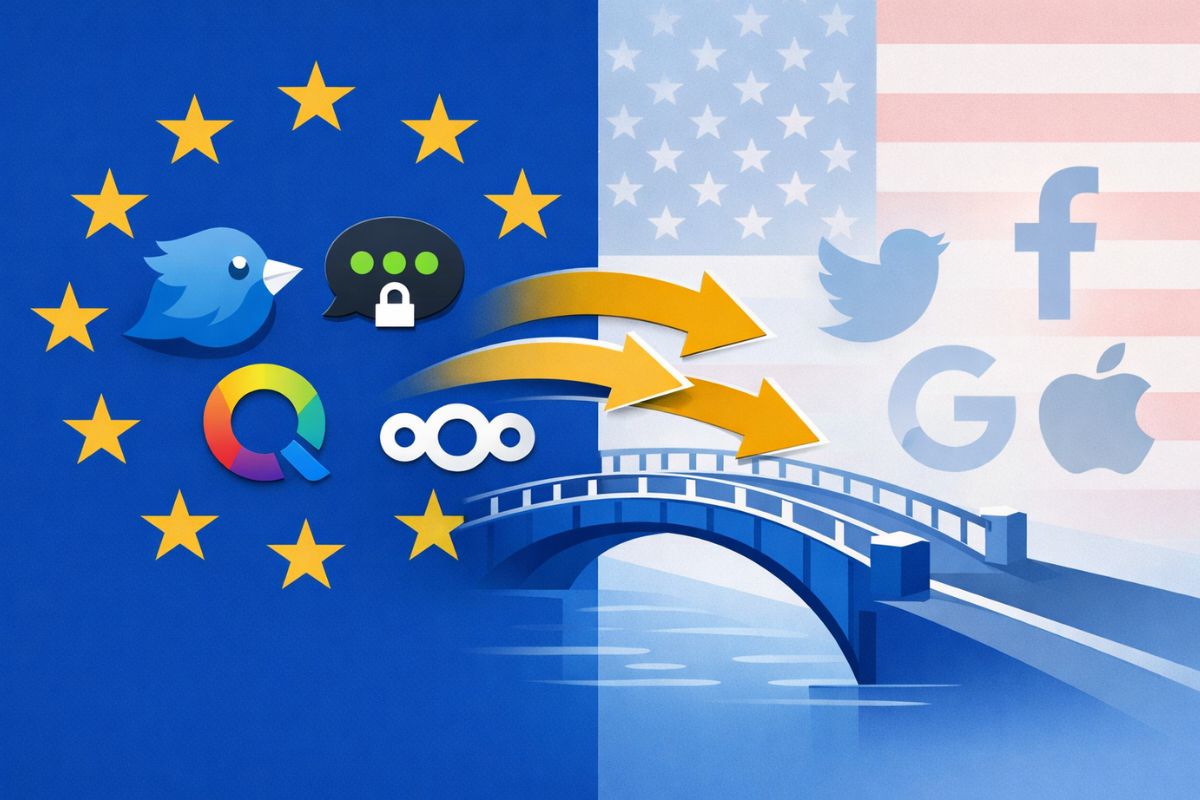
Europeans are abandoning US tech giants in growing numbers, turning instead to homegrown alternatives. The movement spans from everyday apps to government infrastructure, driven by privacy concerns, political tensions, and a push for digital independence.
Online communities dedicated to finding European replacements for American platforms are exploding. The Reddit group r/BuyFromEU has attracted more than 230,000 members, according to Tuta. Another forum focused on reducing Google’s dominance has over 250,000 followers. The website European Alternatives saw an 1,100 percent traffic surge in 2025, according to analytics platform Plausible.
Why the Shift?
Data privacy stands at the center of European concerns. Constantin Graf, a software developer from Vienna who created european-alternatives.eu, explained that supporting local businesses helps communities because taxes paid by companies return indirectly and create regional jobs.
The US CLOUD Act allows American authorities to access data from US companies regardless of where it is stored. This conflicts directly with Europe’s General Data Protection Regulation, which gives users strict control over their personal information.
Political developments have accelerated the trend. Recent corporate behavior involving major tech CEOs has pushed more users away from US platforms. When Elon Musk acquired Twitter and rebranded it as X, many European users migrated to Mastodon, a decentralized platform with servers hosted across Europe.
How Europeans Are Making the Switch
Users are replacing American apps across multiple categories. For email, they choose Mailbox.org, Posteo, or Proton Mail from Switzerland instead of Gmail. French search engine Qwant and German Ecosia replace Google Search. Norwegian browser Vivaldi competes with Chrome.
The shift extends beyond individual users. The International Criminal Court in The Hague announced in November 2025 it was replacing Microsoft office software with OpenDesk, an open-source alternative delivered by the German Centre for Digital Sovereignty. The decision came after chief prosecutor Karim Khan was temporarily locked out of his Outlook email account.
Germany’s Schleswig-Holstein state is leading the charge by ditching Microsoft tools including Teams, Word, Excel, and Outlook for open-source alternatives. The state completed the migration of more than 40,000 accounts and well over 100 million emails in October 2025. Dirk Schrödter, the state’s digitalization minister, said the move helps the state regain control over data storage and ensure digital sovereignty.
France’s Ministry of Economics and Finance completed NUBO, a private cloud initiative for handling sensitive data.
In July 2025, Germany, France, Italy, and the Netherlands established the European Digital Infrastructure Consortium for Digital Commons to jointly develop and scale sovereign digital tools.
What Are the European Alternatives?
Social Media & Communication
| US App | European Alternative |
|---|---|
| Mastodon (Germany) | |
| Twitter/X | Mastodon (Germany) |
| Threema (Switzerland) | |
| Zoom | Wire (Switzerland) |
Productivity & Cloud
| US App | European Alternative |
|---|---|
| Google Workspace | OnlyOffice (Latvia), NextCloud (Germany) |
| Microsoft Office | LibreOffice (Germany) |
| Google Drive | NextCloud (Germany), Internxt (Spain) |
| Dropbox | pCloud (Switzerland) |
Search & Browsing
| US App | European Alternative |
|---|---|
| Google Search | Qwant (France), Ecosia (Germany) |
| Chrome | Vivaldi (Norway), Mullvad (Sweden) |
Entertainment & Other
| US App | European Alternative |
|---|---|
| Spotify | Deezer (France) |
| YouTube | PeerTube (EU) |
| ChatGPT | Mistral Le Chat (France) |
Challenges Remain
Complete independence from US tech remains difficult. Some European alternatives lack the features or polish of American counterparts. Even when organizations choose European providers, acquisitions can undermine those decisions. In November 2025, American IT giant Kyndryl announced plans to acquire Solvinity, a Dutch cloud provider serving Dutch government clients who had specifically chosen it to avoid US firms.
The conflict between the CLOUD Act and European data protection law creates practical barriers, as organizations must conduct Data Protection Impact Assessments before deploying technology that might compromise user data.
The movement represents more than consumer preference. It reflects European determination to control digital infrastructure and protect fundamental rights. Whether this translates into lasting change depends on continued political will and the ability of European companies to match American innovation while respecting privacy.
Support us to sustain independent environmental journalism in India.
Keep Reading
Story of Mala Nimbalkar: Rag Picker to Manager of MRF centre in Bhopal
In Bhopal’s Idgah Hills, Who is Segregating Our Plastic Waste?