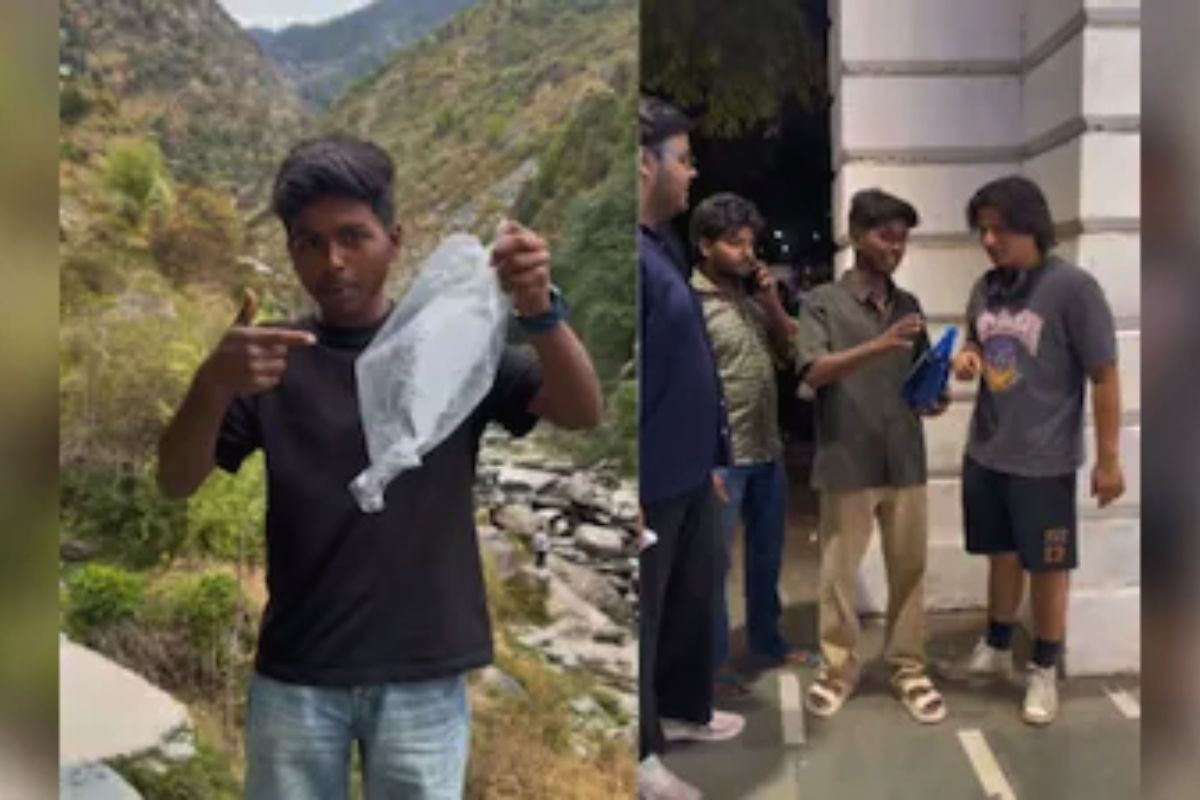
A young man from Delhi recently travelled to Himachal Pradesh, filled several bottles with mountain air using a pressure sprayer, and set up an informal stall at Connaught Place. He charged ₹50 per bottle. People stopped, paid, opened the bottles, and breathed in.
The video went viral on social media in late March 2026, reported by TV9 Bharatvarsh, drawing hundreds of thousands of views and widespread praise for what many called an out-of-the-box business idea.
The appeal was not medical. It was experiential.
Delhi recorded an AQI was nearly 700 early this year, classified as severe plus by India’s pollution control authority, indicating hazardous conditions with significant health impacts. In 2025, Delhi recorded zero good air quality days across the entire year, with residents breathing air that fell into unhealthy categories on nearly every single day.
Against that backdrop, the idea of paying for clean mountain air, however briefly, found a ready audience.
Is It Actually Possible to Bottle Air?
Yes, and it has been done commercially for years.
Canadian company Vitality Air was founded in 2015 after its founders tested the idea by listing a plastic bag of Canadian mountain air on eBay, which sold for 99 cents. They went on to invest around one million dollars to build a bottling facility, compressing fresh air from the Rockies into cans sold with a breathing apparatus for around 32 US dollars each.
The canned air market operates largely without regulation, and while studies have shown that clean air is preferable to polluted air, there are no studies to suggest that breathing clean air from a can in short bursts has measurable health benefits, according to experts cited by The Hustle.
The Delhi boy’s method, a pressure sprayer and standard bottles, is far more rudimentary and raises questions about how much air is actually retained, at what pressure, and for how long. No independent verification of the air’s origin or composition has been reported.
A Novelty With a Real Point
In 2016, the Gas Authority of India Limited sponsored a campaign in Delhi motivated by an earlier social experiment involving the selling of packaged air, with the aim of drawing attention to collective efforts around air quality. The Delhi boy’s stunt follows in that tradition, part commerce, part commentary.
Experts at Hong Kong Polytechnic, when asked about similar bottled air businesses in China, noted that buying bottles of air is not a solution to pollution, and that most buyers are drawn to the product as a novelty rather than for practical use.
What the Numbers Behind the Idea Say
Delhi’s PM2.5 levels average 200 micrograms per cubic metre in winter, a figure associated with a 15 to 20 percent rise in respiratory diseases, according to a 2025 review published in Discover Atmosphere. Between 2022 and 2024, over 204,000 cases of acute respiratory infection were reported to emergency departments across six central government hospitals in Delhi, of which more than 30,000 required hospital admission.
These numbers are the real context behind the ₹50 bottle. The stunt worked because the desperation it referenced is genuine.
The Delhi boy has not announced a formal business. The video was produced under the Instagram handle @deluxebhaiyaji, which has previously run similar street experiment videos, including one in which Kashmir snow was flown to Delhi and sold. Both videos drew large audiences and significant media coverage.
Whether the air was truly from Himachal, and whether it retained any meaningful difference from Delhi’s own atmosphere by the time someone opened the bottle, remains unverified. What is verified is that people paid for it — and that, in a city that recorded not one clean-air day in an entire year, that says something on its own.
Support Us To Sustain Independent Environmental Journalism In India.
Keep Reading
Highway Halt Puts Kashmir’s Fruit Economy at Risk
Railway line expansion plan put Kashmir’s apple orchards at risk
Warmer winters in Kashmir raise concerns over apple and crop yields
Stay Connected With Ground Report For Underreported Environmental Stories.