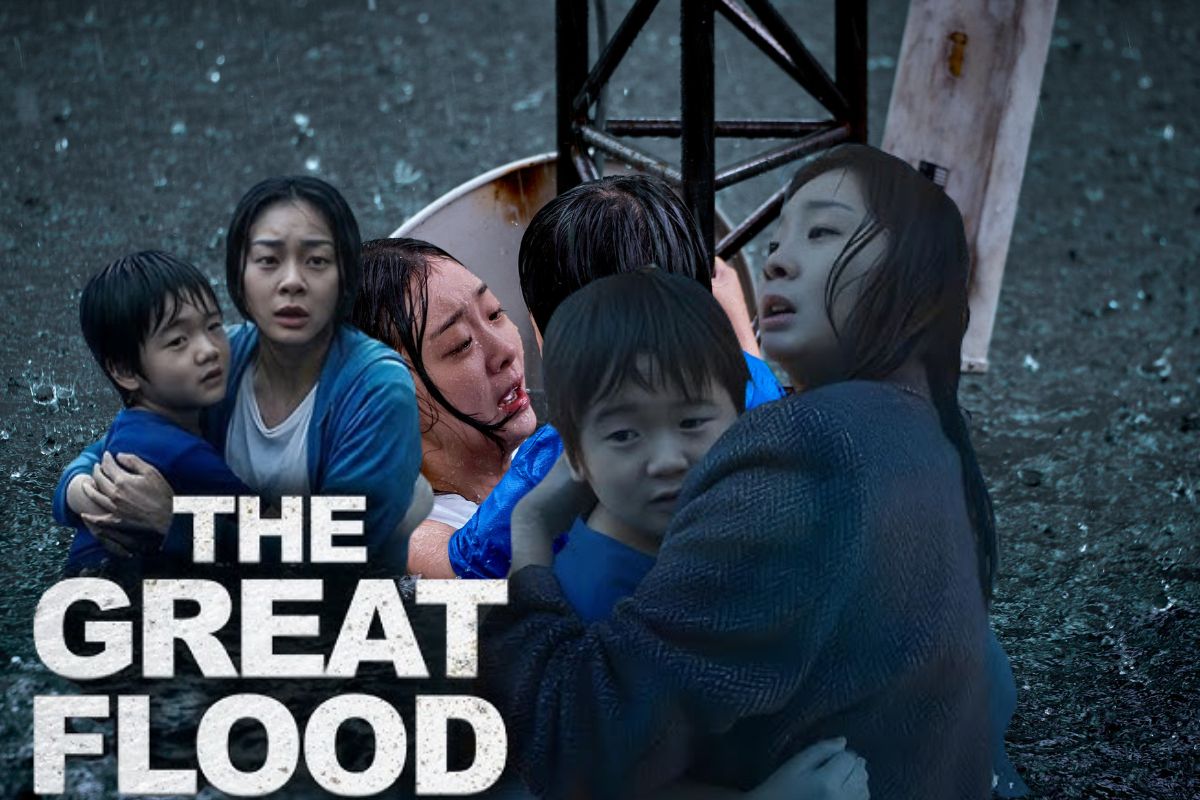
Korean disaster film The Great Flood has topped Netflix platform’s global charts for non-English films, overtaking holiday favorites with its apocalyptic storyline. Director Kim Byung-woo’s science fiction thriller stars Kim Da-mi and Park Hae-soo in a story that begins as a disaster movie but transforms into something far more complex.
The film follows An-na, a mother in Seoul, as she fights her way up a high-rise building with her young son Ja-in while floodwaters consume the city. What starts as a desperate survival story reveals layers of artificial intelligence, memory loops, and questions about humanity’s future. The movie premiered at the Busan International Film Festival in September 2025 before streaming on Netflix from December 19.
Director Kim Byung-woo described his vision for the project in clear terms. “Water is called a ‘water demon’ in disasters, but it is also the source of life,” he said. He explained that if human emotions could be visualized, they might take the form of massive waves.
What Is The Great Flood All About?
An-na wakes one morning to find her Seoul apartment building engulfed by rising floodwaters after an asteroid struck Antarctica, causing sea levels to surge worldwide. She grabs her six-year-old son and begins climbing upward through the flooding structure. During their desperate ascent, they encounter other residents: looters ransacking apartments, an older couple calmly accepting their fate, a trapped girl in an elevator, and a woman going into labor.
Security officer Son Hee-jo appears to help An-na and Ja-in reach the rooftop where evacuation awaits. But the situation grows darker when soldiers seize Ja-in and extract his consciousness into a digital storage device, revealing he was never biologically born but an artificial child created from An-na’s AI research. An-na learns she works for the Darwin Center, developing the Emotion Engine, technology designed to give synthetic humans genuine feelings.
An-na boards a rocket bound for orbit, but debris strikes the vessel. She suddenly finds herself back in her apartment at the flood’s start. The cycle repeats thousands of times as An-na relives variations of the disaster. Each loop teaches her more about sacrifice and maternal instinct. Through her phone, she discovers thousands of digital paintings sent by Ja-in, each depicting different timeline variations.
5 Things You Should Know to Understand Movie
1. The Flood Is Real, But Not Everything Is
The original timeline shows An-na mortally wounded during the actual flood and later rescued by spacecraft. Before dying, she requests her mind be uploaded into a computer system designed to create artificial humans. The flooding disaster happened. Everything viewers see afterward occurs within simulations testing emotional responses.
2. An-na and Ja-in Are Part of an Experiment
An-na volunteered for an experiment where she would care for a synthetic child to see if she could develop genuine maternal instinct. The child in her care is Ja-in. Her memories from five years of raising him, including trauma from her husband’s drowning in a car accident, become data for the Emotion Engine. The simulation forces An-na to experience losing Ja-in repeatedly until she proves the depth of maternal love.
3. Time Loop Tests Human Emotion
Simulations recreate the final hour, deliberately separating An-na and Ja-in to force her to experience the anguish of searching for him over and over. Each failure refines the AI’s understanding of human emotion. Only after thousands of cycles does An-na finally succeed in saving her son, completing the emotional engine test. The experiment proves emotions cannot be programmed, they must be lived through experience.
4. Ending Remains Deliberately Ambiguous
After thousands of cycles, An-na succeeds in finding Ja-in, enabling the system to build new artificial bodies for both of them. The final scene shows them together, headed for Earth. But the movie never clarifies whether this is the original An-na with restored memories or a synthetic version created from her experiences. This ambiguity raises questions about whether humanity has been saved or replaced entirely.
5. Critics Are Divided Despite Viewer Success
The film holds a 47 percent score on Rotten Tomatoes, with reviews describing it as ambitious with shocking twists but slightly uneven. Some critics praised the visual effects and Kim Da-mi’s committed performance. Others found the narrative structure confusing and overloaded with concepts. Director Kim Byung-woo acknowledged the physically demanding production. “At our first meeting, she asked, ‘Will my clothes stay wet the whole time?’ And indeed, her clothes were wet throughout the filming,” he recalled.
The movie blends disaster spectacle with philosophical questions about artificial intelligence, consciousness, and what defines humanity. Kim Byung-woo revealed his intent: “In the film, there’s a line: ‘Humans must create emotions,’ and emotions are what form human relationships”. Whether viewers find the film profound or convoluted depends on their tolerance for narrative complexity layered onto survival thrills.
Watch The Great Flood on Netflix now.
Support us to keep independent environmental journalism alive in India.
Keep Reading
Small Wild Cats in Big Trouble: India’s First National Report Released
After Tragedy, Families Face Delays in Tiger Attack Compensation
Stay connected with Ground Report for underreported environmental stories.