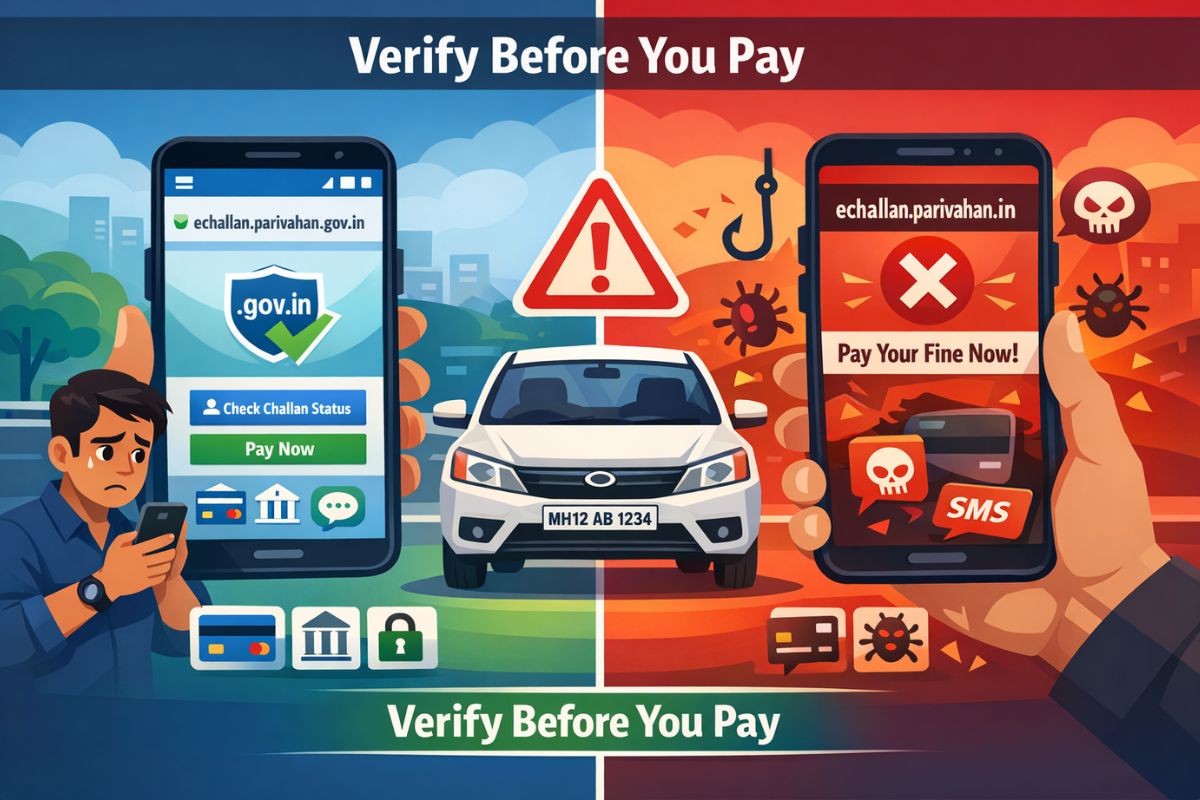
Thousands of Indian vehicle owners are receiving fake traffic violation messages that look official but lead to financial fraud. The Ministry of Electronics and Information Technology has issued warnings about a widespread e-challan scam that has already cost victims lakhs of rupees.
The scam uses text messages, WhatsApp, and emails that appear to come from traffic police or Regional Transport Offices. These messages contain payment links that steal banking information instead of settling actual traffic fines.
What Is an E-Challan Scam?
An e-challan scam involves fraudsters sending fake traffic violation notices to vehicle owners. These messages claim the recipient has committed a traffic offense and must pay a fine immediately.
The fake messages copy the format used by real traffic authorities. They include vehicle numbers, challan numbers, fine amounts, and official-sounding language. The goal is to trick people into clicking malicious payment links.
Real e-challans are electronically generated traffic tickets issued by police for violations like speeding or signal jumping. Legitimate challans can be paid through official government portals. Scammers exploit this convenience by creating fake portals that steal money and personal data.
How Does Traffic Challan Scam Work?
The scam follows a simple pattern. You receive a message stating your vehicle has been charged a fine. The message reads something like: “Your Challan No. is 123456 for vehicle number MH02AB1234 having challan amount as Rs 500. For online payment visit echallanparivahan.in. You can also contact RTO office for disposal of challan.”
The message creates urgency by suggesting legal consequences if you do not pay immediately. Some versions threaten vehicle impoundment or license suspension.
When you click the payment link, you reach a fake website that looks like the official Parivahan portal. The site asks for your banking details, credit card information, and OTP codes. Once you enter this information, scammers drain your bank account.
Some scams use a different method. They ask you to download an application file through WhatsApp or Telegram. These files contain malware that accesses your phone remotely and captures all sensitive data, including banking passwords.
What to Keep in Mind When You Get a Challan Message
Traffic authorities never send urgent payment demands. Real challans do not threaten immediate legal action or vehicle seizure. If a message creates panic or demands instant payment, it is likely fraudulent.
Genuine traffic departments do not ask for payments through UPI IDs, mobile wallets like Paytm or Google Pay, or personal phone numbers. All legitimate payments go through official government payment gateways.
Look carefully at the sender’s details. Official messages come from verified government numbers or email addresses ending in .gov.in. Fake messages often come from regular mobile numbers or email addresses that look similar to official ones but contain small differences.
Never download applications or files sent through WhatsApp, Telegram, or text messages claiming to be traffic challan apps. These are malware designed to steal your data. Only download apps from official sources like Google Play Store or Apple App Store after checking ratings and reviews.
How to Check If a Challan Is Fake
You can verify any e-challan by examining three key elements.
First, check if the vehicle number matches your actual registration. Vehicle numbers can be verified against your registration certificate or the number plate on your vehicle.
Second, verify the challan number. Log into the official e-challan website at echallan.parivahan.gov.in and enter the challan number. If the number does not exist in the system, the message is fake.
Third, examine the payment link carefully. Scammers use links that look very similar to official ones. The fake link might read echallanparivahan.in while the genuine government website is echallan.parivahan.gov.in. All authentic government websites contain .gov.in in their domain address.
Check for spelling and grammar errors in the message. Official communications from traffic departments are professionally written. Poor grammar or spelling mistakes indicate fraud.
Where to Find Real Challan Information
The official national portal for checking traffic challans is echallan.parivahan.gov.in. This website is maintained by the Ministry of Road Transport and Highways.
Visit the Parivahan Sewa portal and click on “Check Challan Status.” Enter your vehicle registration number or challan number to view all pending fines. The system shows violation details, dates, locations, fine amounts, and payment options.
Each state also maintains its own RTO website where you can verify challans. Delhi residents can check at delhi.gov.in, Maharashtra at mahatransport.in, and Karnataka at transport.karnataka.gov.in.
You can also visit your nearest RTO office in person to verify any challan. Bring your vehicle registration certificate for identification.
Real vs Fake Challan: Key Differences
| Feature | Real Challan | Fake Challan |
|---|---|---|
| Website Domain | Contains .gov.in (echallan.parivahan.gov.in) | Missing .gov.in (echallanparivahan.in) |
| Payment Method | Official payment gateway only | UPI, wallets, personal accounts |
| Message Tone | Professional, no threats | Urgent, threatening language |
| Sender | Verified government number or .gov.in email | Regular mobile number or suspicious email |
| Download Requests | Never asks to download apps | Requests APK or app downloads |
| Verification | Challan number exists on official portal | Challan number not found in system |
Real Cases Show Scale of the Problem
A Vadodara businessman lost Rs 34.75 lakh after installing a fake app called RTO e-challan.apk received through WhatsApp. The application accessed his banking details and completed unauthorized transactions.
In Nashik, a man lost Rs 6 lakh after responding to a fraudulent RTO challan SMS. The malware file gave scammers remote access to his phone.
Multiple Coimbatore residents received scam messages on WhatsApp asking them to download fake applications. One victim lost Rs 2.96 lakh.
A Rajkot shop owner downloaded what appeared to be a legitimate traffic challan app and lost Rs 10.81 lakh. The app captured his sensitive banking information.
Police in Kochi arrested two suspects who were spreading counterfeit Parivahan apps through WhatsApp. The operation used a Telegram bot to gather vehicle information and steal victims’ financial records.
What to Do If You Receive a Suspicious Challan
Do not click any links in the message, Do not download any files or applications. Do not make any payments.
Visit the official Parivahan website directly by typing the address into your browser. Check if any genuine challans exist against your vehicle.
Report suspicious messages immediately to the Cyber Crime Portal at cybercrime.gov.in. File a complete complaint with all message details.
Inform your local traffic police helpline about the fraudulent message. Block the sender’s number and delete the message from your device.
If you already clicked a suspicious link or shared banking information, contact your bank immediately to block your cards and accounts. Change all online banking passwords.
Share information about the scam with family, friends, and colleagues. Awareness prevents others from becoming victims.
Set a weekly reminder to check for real traffic challans on official portals. This habit ensures you stay informed about legitimate violations without falling for scams.
Support us to keep independent environmental journalism alive in India.
Keep Reading
Small Wild Cats in Big Trouble: India’s First National Report Released
After Tragedy, Families Face Delays in Tiger Attack Compensation
Stay connected with Ground Report for underreported environmental stories.