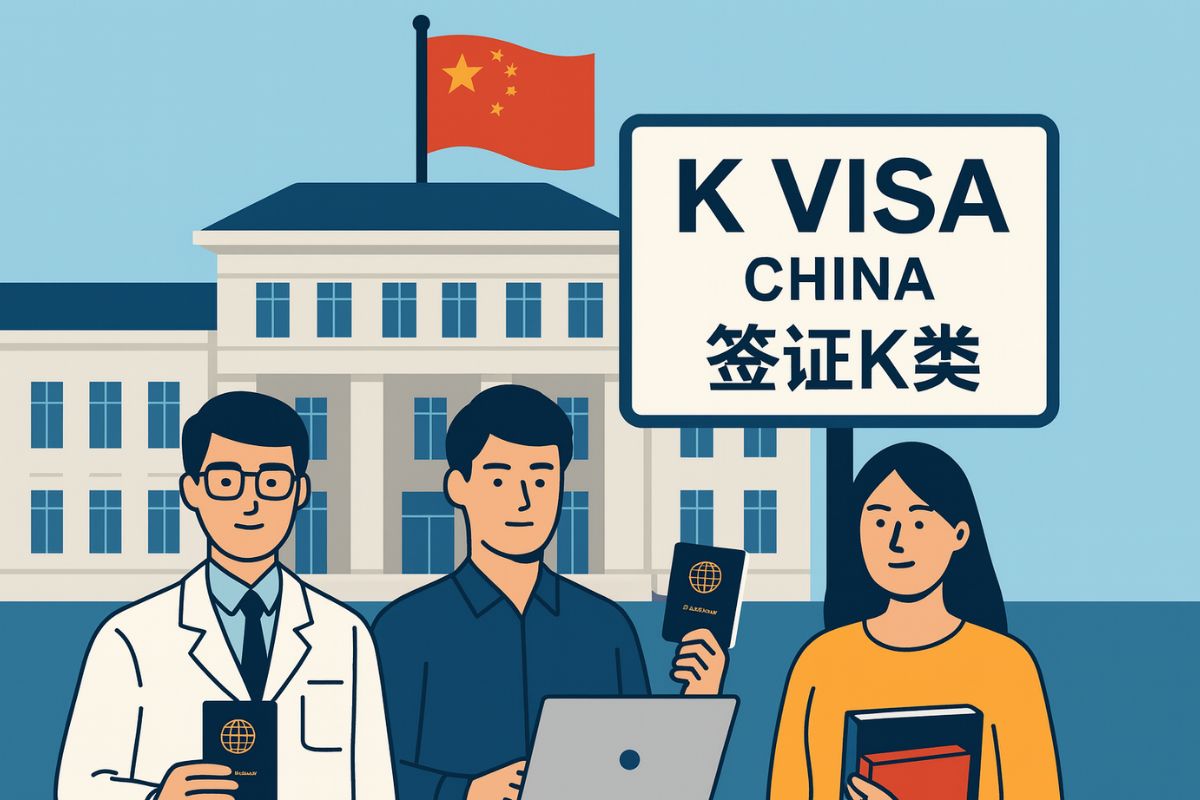
China has announced a new “K visa” to attract young professionals in science and technology fields. The move comes as the United States raises its H-1B visa fee to $100,000, creating uncertainty for skilled workers worldwide.
The new visa will take effect on October 1, 2025, after amendments to China’s entry and exit regulations were approved in August. Premier Li Qiang signed the decree earlier this month, according to state news agency Xinhua.
The K visa is part of China’s wider plan to compete for global talent in science, technology, engineering, and mathematics. It offers multiple entries, longer validity, and extended stays compared to existing visa types.
Applicants do not need sponsorship from a local employer, making the process less restrictive than most work visas. China’s Ministry of Justice said the program is designed to “create opportunities for global youth while supporting China’s development.”
What is K visa?
The K visa is a new category created to attract young professionals in science and technology. It provides more flexibility than China’s 12 existing visa types and focuses on early-career talent rather than senior experts.
Unlike most work visas, the K visa does not require applicants to have an invitation from a local employer. Instead, eligibility is based on education, age, and work experience. The government says the process will be “streamlined and practical.”
The visa allows holders to take part in research, cultural and academic exchanges, entrepreneurship, and business activities. Officials say this wide scope is intended to strengthen international cooperation in key sectors.
Who can apply for it?
The Ministry of Justice has set eligibility rules for applicants. Candidates must hold a bachelor’s degree or higher in a STEM field from a recognized university in China or abroad.
Young professionals engaged in teaching or research at approved institutions may also qualify. Applicants must submit proof of their qualifications and meet age and work experience requirements.
Key eligibility points:
- STEM graduates with at least a bachelor’s degree.
- Professionals engaged in teaching or research.
- Must meet set age and work experience criteria.
- Required documents include academic credentials and employment or research records.
Step by step: How to apply for the K visa
Step 1: Check eligibility on the Chinese government or embassy website. Prepare degree certificates, transcripts, a CV and evidence of research or teaching.
Step 2: Wait for embassy guidance. Chinese embassies and consulates will publish the exact documentary list and application forms before October 1.
Step 3: Submit the visa application to the Chinese embassy or consulate in your country, with originals or certified copies as required. Attend any consular interview if requested.
Step 4: Follow any post-entry rules set by local authorities after arrival, including registration or residence-permit procedures where applicable. Officials say details will appear in the official guidance.
Can Indians apply for the K visa?
Yes. The K visa is open to applicants from all countries, including India. The announcement comes at a time when many Indian professionals are reconsidering career opportunities in the United States due to higher visa costs.
FAQ on China’s K visa
When does the K visa start?
The K visa rules will take effect on October 1, 2025.
Do I need a Chinese employer to sponsor me?
No. Applicants do not need a local employer’s invitation. Eligibility is based on education, age, and experience.
What activities are allowed under the K visa?
Holders can take part in research, cultural exchanges, entrepreneurship, and business projects.
Is the K visa permanent residency?
No. The K visa allows extended stays and multiple entries, but it is not a path to permanent residency.
How can I apply?
Applicants must apply through Chinese embassies or consulates. Detailed requirements on age limits, STEM fields, and visa validity will be published closer to October.
Support us to keep independent environmental journalism alive in India.
Keep Reading
Small Wild Cats in Big Trouble: India’s First National Report Released
After Tragedy, Families Face Delays in Tiger Attack Compensation
Stay connected with Ground Report for underreported environmental stories.
Follow us onX, Instagram, and Facebook; share your thoughts at greport2018@gmail.com; subscribe to our weekly newsletter for deep dives from the margins; join our WhatsApp community for real-time updates; and catch our video reports on YouTube.
Your support amplifies voices too often overlooked, thank you for being part of the movement.