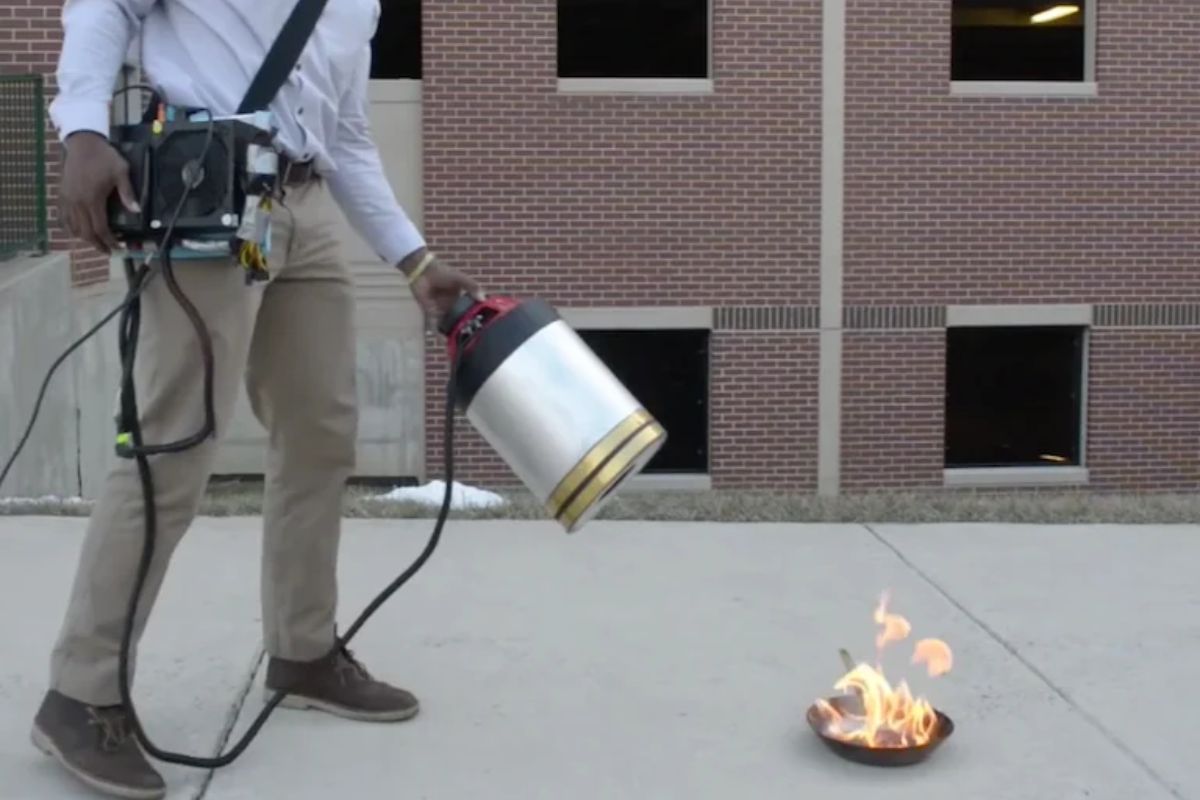
At Government Polytechnic Sundernagar in Himachal Pradesh, a group of students has built a low-cost device that puts out fire using nothing but sound. No water. No chemicals. Just waves of pressure aimed at a flame, and the flame dies.
The students used sound frequencies between 30 and 60 Hz to build their prototype, keeping costs low enough to show that this kind of technology does not have to stay inside expensive research labs. Their work puts them alongside engineers and scientists around the world who are chasing the same idea.
How Does Sound Kill a Flame?
A flame needs three things to survive: heat, fuel, and oxygen. Take away any one of them, and the fire goes out. Sound waves are pressure waves, they push air molecules back and forth. At the right frequency, that movement pulls oxygen away from the flame, breaking the combustion reaction before it can continue.
“It’s basically vibrating the oxygen faster than the fuel can use it, so you block the chemical reaction,” says Geoff Bruder, an aerospace engineer and co-founder of Sonic Fire Tech, a company he started after researching thermal energy conversion at NASA. His team has demonstrated fire suppression from up to 25 feet away.
Albert Simeoni, head of the fire protection engineering department at Worcester Polytechnic Institute in Massachusetts, says the science is well established. “Acoustic influence on flames is well known in combustion,” he told Scientific American. “The challenge is to scale up the technology without creating disrupting or even damaging sound effects.”
From DARPA to Dorm Rooms?
This is not a new idea. The U.S. Defense Advanced Research Projects Agency studied acoustic fire suppression between 2008 and 2011. But it grabbed wider attention in 2015, when two engineering students from George Mason University in Virginia built a working extinguisher for around $600.
Seth Robertson and Viet Tran designed the device as a senior research project. Their prototype used an amplifier to generate low-frequency sound and a collimator, a device that focuses sound waves, to direct pressure straight at the flame. They found that frequencies between 30 and 60 Hz worked best. These are deep bass tones, the kind you’d hear in hip-hop or electronic music.
The device left no chemical residue, caused no water damage, and was portable enough to carry by hand. Robertson and Tran filed for a patent and said they planned to keep refining the invention.
What’s Actually Being Built Now?
Sonic Fire Tech is taking the concept further. Their system uses infrasound, waves at or below 20 Hz, inaudible to humans, that travel farther than higher-frequency waves. A piston driven by an electric motor generates the waves, which travel through metal ducts fitted on rooftops and under eaves. When sensors detect a flame, the system switches on automatically.
Arnaud Trouvé, chair of the fire protection engineering department at the University of Maryland, says the technology works, but only within limits. “They work only on small flames,” he says.
Sonic is currently working with two California utilities to test the system in real conditions. Homeowners have also signed contracts with the company, which was aiming for 50 pilot installations in early 2026.
Scaling this up remains the core problem. What stops a candle or a kitchen grease fire is not yet ready to stop a burning building or a wildfire moving across dry land.
But the gap is closing. From a student workshop in Sundernagar to infrasound systems being tested by California utilities, acoustic fire suppression has moved well past the stage of being just an interesting idea. Whether it becomes a real tool in firefighting depends on whether engineers, from Himachal Pradesh to California, can push the technology far enough to meet the scale of the problem.
Support Us To Sustain Independent Environmental Journalism In India.
More Ground Reports
Panna: Villagers Protest Irrigation Projects, Demand Documents, and Transparency
Fulkai Maai Demands the Return of Crèches for Malnourished Korku Children
Stay Connected With Ground Report For Underreported Environmental Stories.
Support Us To Sustain Independent Environmental Journalism In India.