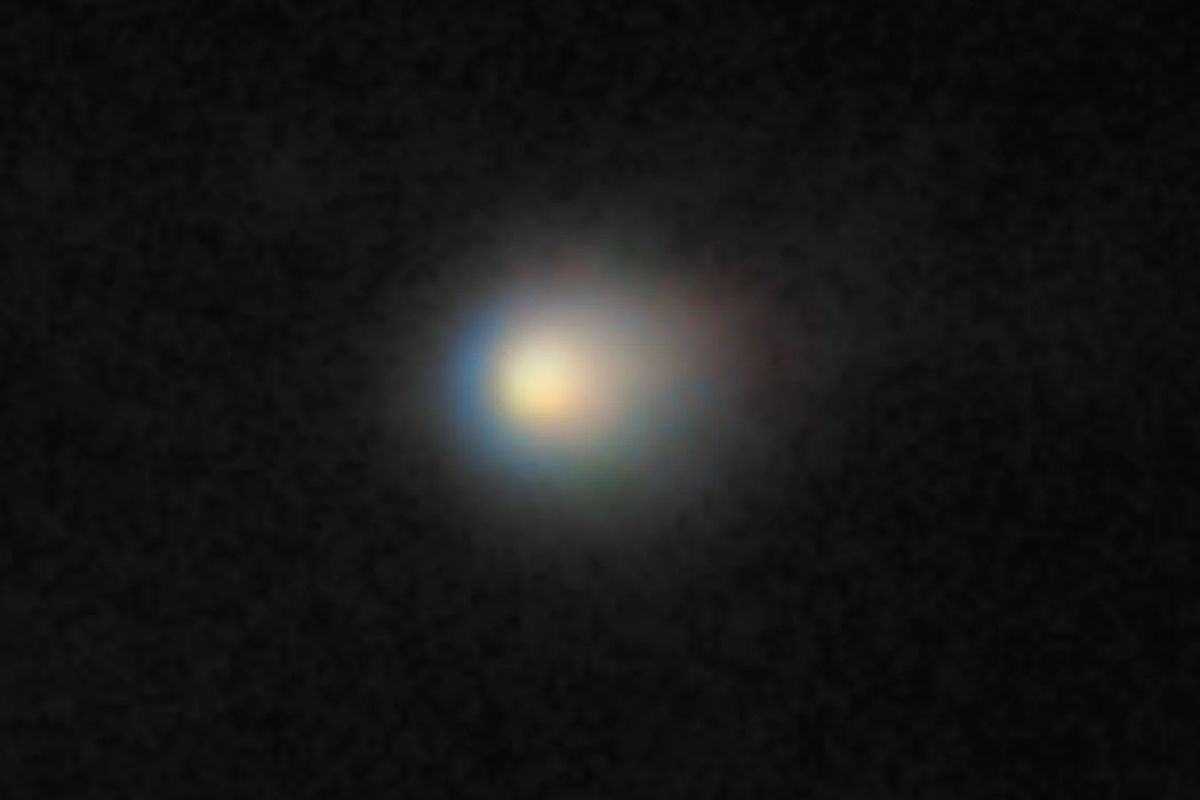
Scientists have detected large amounts of methanol and hydrogen cyanide streaming from interstellar comet 3I/ATLAS. The discovery marks the first detailed chemical analysis of the third known visitor from another star system to pass through our solar neighborhood. The comet also displays a carbon dioxide burst so extreme it nearly erased the water signature, something no object in our system has ever done.
The comet was discovered on July 1, 2025, by the ATLAS telescope in Chile. It travels at more than 210,000 kilometers per hour on a hyperbolic path that will exit the solar system permanently next year. When scientists tracked its orbit back in time, the path led beyond the sun’s neighborhood.
What’s the mystery behind 3I/ATLAS
The comet has refused to sit neatly in the normal comet category since its discovery. It shows strange color shifts, abrupt changes in speed, and both a tail and an anti-tail. Most recently, it displays a 16.16-hour rhythmic brightening and dimming pattern that scientists are still explaining.
Dr. Martin Cordiner and his team at NASA’s Goddard Space Flight Center used the Atacama Large Millimeter/Submillimeter Array in Chile to analyze the comet’s chemistry. Their observations revealed methanol at roughly 40 kilograms per second, making up about eight percent of all vapor escaping from 3I/ATLAS. Solar system comets typically release methanol at only two percent.
Cordiner told New Scientist that these molecules exist only at trace amounts in our own comets. “Here we see that, actually, in this alien comet they’re very abundant,” he said.
Hydrogen cyanide emerges from the rocky nucleus at 250 to 500 grams per second. The methanol appears throughout the coma, the diffuse cloud of gas and dust surrounding the nucleus.
Interstellar Comet 3I/ATLAS Reveals Unusual Chemistry
Scientists have detected large amounts of methanol and hydrogen cyanide streaming from interstellar comet 3I/ATLAS. The discovery marks the first detailed chemical analysis of the third known visitor from another star system to pass through our solar neighborhood. The comet also displays a carbon dioxide burst so extreme it nearly erased the water signature, something no object in our system has ever done.
The comet was discovered on July 1, 2025, by the ATLAS telescope in Chile. It travels at more than 210,000 kilometers per hour on a hyperbolic path that will exit the solar system permanently next year. When scientists tracked its orbit back in time, the path led beyond the sun’s neighborhood.
What’s mystery behind 3I/ATLAS
The comet has refused to sit neatly in the normal comet category since its discovery. It shows strange color shifts, abrupt changes in speed, and both a tail and an anti-tail. Most recently, it displays a 16.16-hour rhythmic brightening and dimming pattern that scientists are still explaining.
Dr. Martin Cordiner and his team at NASA’s Goddard Space Flight Center used the Atacama Large Millimeter/Submillimeter Array in Chile to analyze the comet’s chemistry. Their observations revealed methanol at roughly 40 kilograms per second, making up about eight percent of all vapor escaping from 3I/ATLAS. Solar system comets typically release methanol at only two percent.
Cordiner told New Scientist that these molecules exist only at trace amounts in our own comets. “Here we see that, actually, in this alien comet they’re very abundant,” he said.
Hydrogen cyanide emerges from the rocky nucleus at 250 to 500 grams per second. The methanol appears throughout the coma, the diffuse cloud of gas and dust surrounding the nucleus.
Comet patterns and behavior explained
The comet exhibits a rhythmic brightening pattern that repeats every 16.16 hours. Hubble Space Telescope images showed most of the light comes from the coma, not the solid nucleus. Scientists concluded the pulse results from collimated jets of sublimated material erupting periodically. James Webb Space Telescope measurements show this material jets out at speeds up to 440 meters per second.
Between November 26 and November 28, the X-Ray Imaging and Spectroscopy Mission captured a faint X-ray glow around 3I/ATLAS. The glow extends nearly 250,000 miles from the nucleus. This marks the first confirmed detection of X-rays from an interstellar comet. The X-rays result from charge-exchange reactions between solar wind particles and gas released from the comet’s surface.
The surface reflects sunlight with a deep, saturated red tone that stands out immediately. Teams had seen aging surfaces before, but nothing close to this intensity. The redness seemed too uniform and too persistent to be explained by usual slow weathering of ice.
What we learned from observations
When 3I/ATLAS emerged from behind the sun, researchers expected ordinary behavior. Instead, the earliest readings showed a volatile pattern so lopsided that several researchers questioned whether they were looking at the right object. The water signature barely rose above background levels. Carbon dioxide dominated the spectrum.
Simulations began to explain this pattern. When teams modeled how carbon monoxide behaves under constant exposure to high-energy particles, a pattern surfaced. Carbon monoxide repeatedly broke apart, then reassembled as carbon dioxide. Over countless ages, the crust would become saturated with carbon dioxide, leaving deeper, untouched ice sealed far below.
Radio astronomers detected faint chemical fragments created when sunlight breaks down water vapor. When the MeerKAT radio array locked onto the comet, a specific frequency spike rose just above the background. That tiny emergence confirmed that under all the layers and radiation damage, 3I/ATLAS was still a natural comet.
Methanol serves as a basic building block in prebiotic chemistry. In cold environments where comets form, it acts as a precursor to complex organic molecules that can lead to amino acids and proteins. Cordiner noted the chemical implausibility of reaching high chemical complexity without producing methanol. “It seems really chemically implausible that you could go on a path to very high chemical complexity without producing methanol,” he said.
Harvard astrophysicist Avi Loeb told The Post that methanol functions as an important agent for the origins of life, while hydrogen cyanide at large concentrations acts as poison. “There is much more methanol than hydrogen cyanide,” he said. “In principle, methanol is an important agent for the origins of life.”
The comet also releases hydrogen sulfide, which was used as a chemical weapon in World War I. Earlier observations showed water vapor and gas heavy in carbon dioxide, distinctly redder light, and gas production beginning while still far from the sun.
How many similar visitors exist
3I/ATLAS is only the third interstellar object confirmed passing through our solar system. The other two were 1I/ʻOumuamua and 2I/Borisov. Humans have only been monitoring the sky for such objects for about a decade.
A next-generation survey telescope on Earth is preparing to scan the sky with sensitivity far beyond today’s instruments. Once it begins operations, scientists expect it to detect dozens or even hundreds of interstellar objects each year.
The James Webb Space Telescope plans to image the comet around its closest approach to Earth on December 19. The European Space Agency’s JUICE mission will release a full dataset in February 2026. XRISM will continue monitoring the comet when viewing conditions allow.
Researchers have roughly one year to complete their observations before 3I/ATLAS leaves the solar system forever.
Banner Image Credit: International Gemini Observatory/NOIRLab/NSF/AURA/K. Meech (IfA/U. Hawaii) Image Processing: Jen Miller & Mahdi Zamani (NSF NOIRLab) (CC BY 4.0)
Support us to keep independent environmental journalism alive in India.
Keep Reading
Small Wild Cats in Big Trouble: India’s First National Report Released
After Tragedy, Families Face Delays in Tiger Attack Compensation
Stay connected with Ground Report for underreported environmental stories.