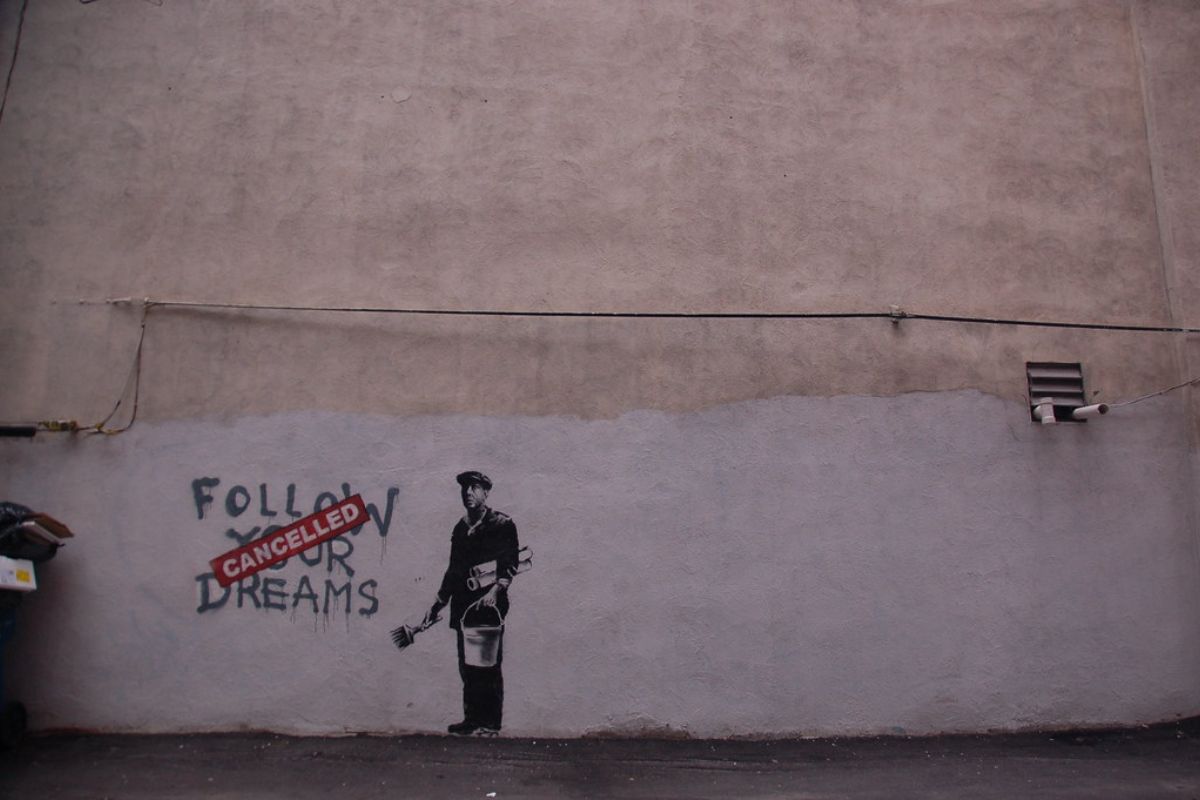
Many widely believe that Robin Gunningham is the renowned graffiti artist Banksy, but Gunningham has neither confirmed nor denied his identity. The world-famous street artist now faces fresh scrutiny after Reuters published an investigation claiming to have finally identified him, and a defamation lawsuit from a former associate adds further pressure on the artist’s carefully guarded anonymity.
The lawsuit alleges that Banksy published false and defamatory statements about the associate in a 2021 book. The associate claims Banksy accused him of being a “traitor” and a “snitch,” and of stealing and selling his artwork. Banksy has rejected all the allegations, vowing to continue creating art.
The name Robin Gunningham is not new. Banksy’s apparent identity had long been an open secret among fellow artists and easy to find online. The Daily Mail reported it in 2008, and the Associated Press published the name in 2016 as part of coverage on earlier detective work. Reuters now reports that after the 2008 Mail story, Banksy changed his legal name to David Jones, the second most popular name in Britain. Banksy’s lawyer did not respond to requests for comment. His spokeswoman declined to participate in the Reuters story.
Who is Robin Gunningham?
The most compelling rumor points to Robin Gunningham, a Bristol native and educated at a public school, is the true identity of the world-famous graffiti artist Banksy. Born in 1973 just a few miles from Bristol, Gunningham’s former schoolmates assert that he is the enigmatic artist.
Criminologists at Queen Mary University of London went so far as to employ geographic profiling in their attempt to identify the street artist back in 2016. This technique, typically utilized for locating repeat offenders, involved analyzing 140 artworks in London and Bristol attributed to the artist to draw their conclusions.
Banksy’s art, frequently showcasing rats and apes, graces the sides of houses and deteriorating walls, not only in Bristol and London but also in locations ranging from the West Bank to Detroit. His artworks command millions in sales, and he has earned the title of Britain’s “most unexpected national treasure.”
Banksy gained recognition as a freehand graffiti artist in 1993. From 2000 onwards, he utilized stencils to expedite his work, forging a distinctive iconography that included easily recognizable images like rats and policeperson to convey his anti-authoritarian message. Banksy ingeniously merged graffiti art with installation and performance, as demonstrated in his 2003 exhibition “Turf War,” where he painted on live pigs.
His “Crude Oils” exhibition in 2005 showcased modified renditions of artworks by Monet, Van Gogh, and Hopper, accompanied by the release of 200 live rats in the gallery. In 2005, Banksy, in complete disguise, surreptitiously installed his pieces in major museums like the Metropolitan Museum of Art and Tate Britain in New York City and London.
Banksy’s former manager, Steve Lazarides, pushed back on the Reuters findings. “There is no Robin Gunningham,” he told Reuters. “The name you’ve got I killed years ago. You’ll never find him.” Lazarides said he helped Banksy legally change his name after the New York incident.
Banksy’s art frequently showcases rats and apes on the sides of houses and crumbling walls, from Bristol and London to the West Bank and Detroit. His works sell for millions and he has earned the title of Britain’s “most unexpected national treasure.”
Art of Banksy
Banksy gained recognition as a freehand graffiti artist in 1993. From 2000 onwards, he used stencils to speed up his work, building a visual language centred on rats and police figures to carry his anti-authoritarian message. His career began in Bristol’s graffiti scene, where he was part of the DryBreadZ Crew. His style draws comparisons to Blek le Rat, who began using stencils in Paris in 1981.
His 2003 exhibition “Turf War” saw him paint on live pigs. In 2005, his “Crude Oils” show featured modified works by Monet, Van Gogh, and Hopper, with 200 live rats released in the gallery. That same year, in disguise, he installed his pieces in the Metropolitan Museum of Art and Tate Britain.
In 2018, his Girl with Balloon shredded itself seconds after selling for £1 million at Sotheby’s. In 2015, he transformed a derelict lido in Weston-super-Mare into Dismaland, a subversive “bemusement park.” He created multiple new works in London in 2025, and his art continued to sell at auction for millions.
Reuters also pieced together that a David Jones travelled to Ukraine with a known associate of Banksy’s in late 2022 — just before the artist’s work began appearing on bombed buildings. Banksy later confirmed he created seven murals in the war zone, including one of a child flipping a man wearing a black belt, a reference to Vladimir Putin’s judo practice.
Impact of Banksy’s Art
The Reuters unmasking has divided the art world. Many fans directed their anger at the news outlet, not the artist.
“I feel like they are telling me how a magic trick is done,” said Thomas Evans, a Denver-based artist. “Sometimes I just want to enjoy the magic trick.”
But experts say his work will survive the revelation. “People buy his works because they absolutely love it,” said Acoris Andipa, director of the Andipa Gallery in London. “The main feedback that I get is that they really, frankly, don’t care if they know who he is.”
Joe Syer, a Banksy expert and founder of MyArtBroker, said the artist has always responded to world events. “And that’s where the real relevance, and value, sits,” he said.
Christopher Banks, founder of the New York-based Objects of Affection Collection, said the naming was “not a biographical event, but a structural stress test” of the artist’s system. “Banksy’s best works carry their meaning without the author. The name matters less than the presence. The presence was always what the work was about,” he wrote.
There is also speculation in the art world that Banksy himself may have orchestrated the unmasking. He did not deny the Reuters report. Madeleine White, senior sales consultant at London’s Hang-Up Gallery, said that “would be very much in line with his practice of stunts and satire.”
The defamation lawsuit outcome remains uncertain. Gunningham is named as the first defendant, with Pest Control Ltd — the company Banksy established to sell his art — named as co-defendant. The case has raised important questions about anonymity and freedom of expression. Banksy has not commented publicly. His next move remains unknown.
Support Us To Sustain Independent Environmental Journalism In India.
More Ground Reports
Panna: Villagers Protest Irrigation Projects, Demand Documents, and Transparency
Fulkai Maai Demands the Return of Crèches for Malnourished Korku Children
Stay Connected With Ground Report For Underreported Environmental Stories.
Support Us To Sustain Independent Environmental Journalism In India.