
Choosing the right inverter battery is equally essential to picking the inverter itself. Although a lot of buyers tend to chiefly select the capacity or the brand, the battery type determines the performance, durability, and overall reliability to a great extent. With so many options in the market, the real issue is how to know which technology is the most suitable for your usage.
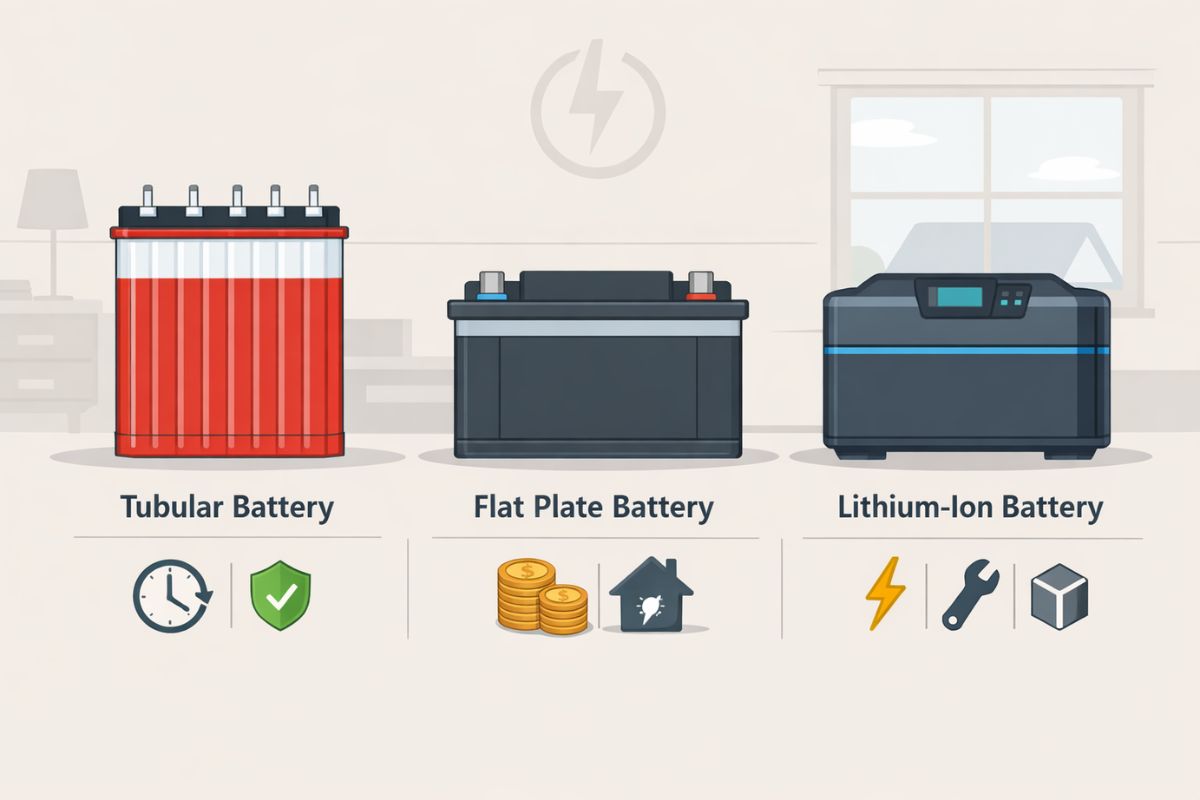
Currently, inverter batteries are predominantly of three types: tubular, flat plate, and lithium-ion. They each have different advantages, disadvantages, and price considerations. Being aware of their differences can save you from frequent replacements, needless maintenance, and inefficiencies in the long run.
Why Battery Type Matters More Than Most Buyers Realise
Previously, the choice of inverter batteries was quite limited, and the majority of families depended on similar lead-acid types. However, as power requirements grew and technology progressed, the battery’s ability to perform became the main factor for trustworthy backup.
The right battery type affects:
- Backup duration
- Charging efficiency
- Maintenance requirements
- Space utilisation
- Long-term operating cost
Selecting the wrong option can lead to reduced backup, faster wear, and higher running expenses—regardless of how advanced the inverter is.
Understanding the Three Main Types of Inverter Batteries
Before comparing them, it helps to understand what makes each battery type different in design and function.
Tubular Batteries
Tubular batteries are among the most commonly used options in residential settings. It comes with tubular-shaped plates to reduce corrosion and enhance the durability of the battery, which is one of the main advantage for the tubular battery.
Here are some of the features:
- Has a very long life span compared to other batteries
- Can be charged and discharged several times without losing their strength
- Perfect for regions/water outages/stretches of power failures that are of long duration
Tubular configurations make it possible for the active material to stay unchanged for a longer time, hence providing more stable performance.
Flat Plate Batteries
Flat plate batteries are the legacy technology of battery which power backup basic needs. The simplicity of their internal structure consists of flat lead plates, which are immersed in the electrolyte.
Features:
- Has a lower price at its first purchase
- Has a small size/highly suitable for a small area
- In some cases able to charge faster
They are, however, less capable of withstanding sustained heavy usage and very few deep discharges.
Lithium-Ion Batteries
Lithium-ion batteries are the most recent inventions in the sector of inverter battery technology. With the help of sophisticated Battery Management Systems (BMS), this type of battery smoothly handles charging, discharging, and safety.
Important features:
- Extremely high energy storage capacity
- Low running cost/ very low maintenance
- The charging cycle is very fast
- Small size and very lightweight
These batteries are the answer to contemporary household energy use and are typically the choice for homes with solar panels and/or less space.
Performance Comparison: Which Battery Delivers Better Results?
To understand which option suits your needs, comparing performance factors is essential.
| Feature | Tubular | Flat Plate | Lithium-Ion |
| Backup Consistency | High | Moderate | Very High |
| Lifespan | Long | Short to Moderate | Very Long |
| Charging Speed | Moderate | Moderate | Fast |
| Maintenance | Regular | Regular | Minimal |
| Space Efficiency | Average | Good | Excellent |
From a performance standpoint, lithium-ion batteries lead in efficiency, while tubular batteries offer balanced reliability at a lower cost.
Cost Considerations and Long-Term Value
Initial pricing often influences decisions, but long-term value matters more.
- Flat plate batteries have the lowest upfront cost but may require replacement sooner.
- Tubular batteries cost more initially but offer better durability and longer service life.
- Lithium-ion batteries have the highest upfront price but provide savings through efficiency, longevity, and minimal maintenance.
When evaluating inverter batteries, it is important to consider the total cost of ownership rather than just the purchase price.
Maintenance and Usage Requirements
Maintenance is a major factor for many households.
- Tubular and flat plate batteries require periodic water top-ups and proper ventilation.
- Lithium-ion batteries are sealed units with no electrolyte maintenance needs.
Users who prefer low-maintenance solutions often lean toward lithium-ion, while those comfortable with routine upkeep may find tubular batteries sufficient.
Suitability Based on Usage Patterns
Different households use electricity differently.
- Homes that experience power outages for a long time: Tubular batteries can be counted on for reliable long-term performance.
- Homes that face power outages that are very short and infrequent: Flat plate batteries can work just fine.
- Homes that have solar panels or use other energy-saving methods: Lithium-ion batteries will definitely outperform the rest in terms of efficiency and compatibility.
Matching battery type to usage prevents unnecessary stress on the system.
Environmental and Safety Considerations
Nowadays, a lot of people take the environment and safety into consideration when making decisions.
Lithium-ion batteries not only emit less waste during the time of their use but are also quite energy-efficient. Nevertheless, in order to be safe, they have to be equipped with a battery management system.
Lead–acid varieties, such as tubular and flat plate batteries, can be recycled, but at the same time, they have to be handled properly and maintained in such a way that leakage or gradual breakdown does not occur.
Choosing the Right Inverter Battery Without Overcomplicating
A simple way of deciding on the right inverter battery is by doing the following:
- Figuring out how much power is consumed each day
- Determining how long the power can be out
- Looking at the space and the ventilation situation that is available
- Considering if one is willing to do maintenance or not
- Thinking about the cost that will be incurred in the future
Instead of opting for the technically most superior product, one can command fewer risks, enjoy more dependable performance, and obtain greater value by choosing inverter batteries that align with actual power usage.
Conclusion
Switching from one brand to another of inverter batteries does not necessarily mean that one is getting a better deal. Further, tubular, flat plates, and lithium-ion batteries are, in fact, quite diverse in their features and advantages, which result in them being suitable for different sets of needs and usage patterns. To make the right choice, you have to first understand the factors of backup needs, maintenance preferences, space, and long-term budget.
Once users comprehend the characteristics of each of these technologies, they will be able to choose the options that not only perform well and are long-lasting, but also fit their budgets, thus achieving convenient, reliable power backup without compromising.
Disclaimer: This content is sponsored and does not reflect the views or opinions of Ground Report. No journalist is involved in creating sponsored material and it does not imply any endorsement by the editorial team. Ground Report Digital LLP. takes no responsibility for the content that appears in sponsored articles and the consequences thereof, directly, indirectly or in any manner. Viewer discretion is advised.
Support us to keep independent environmental journalism alive in India.
Stay connected with Ground Report for underreported environmental stories.