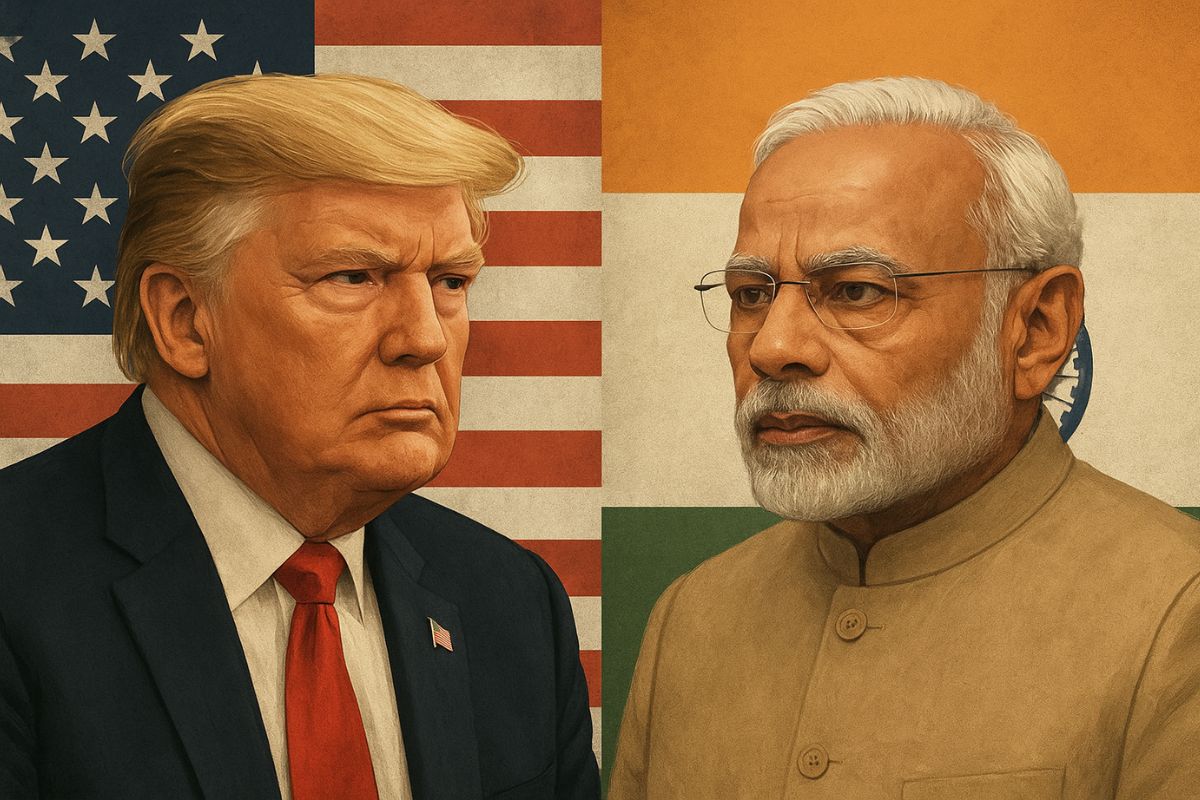
US President Donald Trump’s recent comments and actions suggest a growing strain in his relationship with India and Prime Minister Narendra Modi. Experts believe the dispute has shifted beyond trade and diplomacy into the realm of Trump’s personal ego.
Trump said last week on his social media platform Truth Social, “It seems that we have lost India and Russia to the suspicious China. I hope their company will be pleasant and for a long time.” The post came after Modi, Russian President Vladimir Putin, and Chinese President Xi Jinping were seen together at the Shanghai Cooperation Organization (SCO) summit in China.
Trump Modi tensions
Indian officials say the shift in Trump’s tone has been visible for months. He has repeatedly expressed frustration over tariffs, trade deficits, and India’s energy ties with Russia. On Friday, US Commerce Secretary Howard Lutnick told Bloomberg, “In a month or two, India will come to the negotiating table and say sorry. India will try to compromise with Trump. After that, Trump will decide how to deal with Modi.”
Tanvi Madan, a senior fellow at the Brookings Institution, said such statements are counterproductive. “America’s strategy of using abusive language and public pressure towards India has always been ineffective. In fact, many times it has had the opposite result,” she wrote on X.
The friction follows a difficult phone call between Trump and Modi after the G7 summit in August. According to a report in the New York Times, Trump invited Modi to Washington, but the Indian leader declined. Indian officials worried Trump would try to stage a public handshake between Modi and Pakistan’s army chief. An Indian official told the paper on condition of anonymity, “This shows how indifferent Trump is about the dispute between India and Pakistan and the sensitivity of their history.”
The disappointment is not limited to leaders. Some groups in India who celebrated Trump’s election last year have turned critical. Vishnu Gupta, president of the Hindu Sena, said his members once supported Trump for his tough stance on Islamic extremism. “But now he is hobnobbing with Pakistan,” Gupta said. “We liked his first term, but not this.”
US-India foreign policy
A survey by the European Council for Foreign Relations in January found that 84 percent of Indians believed Trump’s return to office would benefit India. Since then, the mood has shifted after Trump imposed a 50 percent tariff on Indian goods. Protests have erupted in several Indian cities where effigies of Trump were burned.
Former Indian ambassador Ranjit Rai said the problem is no longer about tariffs alone. “The matter has now become personal,” Rai said. “Trump wants the Nobel Peace Prize. He wanted India to give the credit for the ceasefire. Narendra Modi could not take that risk. What the Indian Prime Minister did is in accordance with India’s foreign policy, but Trump has made it a question of personal ego.”
Other analysts argue that India miscalculated Trump’s approach. James Crabtree, a columnist for Foreign Policy, wrote, “India thought it could manage Trump as well. But Modi’s team has realized its miscalculation, albeit late. The way Trump ended the relationship in one stroke has created a political uproar within India.”
Trump’s India Envoy Pick Sparks Concern
The appointment of Trump ally Sergio Gor as the next US ambassador to India has also raised concerns. Unlike past envoys, Gor has been tasked with handling both India and South and Central Asia. Former Foreign Secretary Shyam Saran said this weakens India’s standing. “It seems that India has been given a part-time ambassador,” Saran told Moneycontrol. “It will be scattered diplomacy that you will sit in Delhi and talk about India-Pakistan as well as India-Bangladesh. This has never happened in the past.”
Salil Tripathi, a writer and board member of PEN International, believes the lesson for India is clear. “Foreign policy moves forward not by hugs but by solid interests,” he wrote in Time magazine. “For Trump, no relationship is sacred. For him, only bargaining matters. Modi thought that he would be able to impress Trump. Trump also likes praise but in the end it is not enough.”
Experts agree that India’s tradition of strategic autonomy clashes with Trump’s transactional style. As Tanvi Madan of Brookings put it, “The US approach of public pressure often backfires with India. Trump has not understood this dynamic.”
For now, the rift continues to widen, leaving both sides uncertain about the future of a partnership once hailed as strong and personal.
Support us to keep independent environmental journalism alive in India.
Keep Reading
Indira Sagar Canal Mismanagement Hurts Barwani Farmers
From First to Failed: Maheshwar Dam Headed for Auction
Water for power plant, but none for people, story of displaced farmers
MP Forests Face One Health Crisis as Cattle, Wildlife Meet
Stay connected with Ground Report for underreported environmental stories.
Follow us on X, Instagram, and Facebook; share your thoughts at greport2018@gmail.com; subscribe to our weekly newsletter for deep dives from the margins; join our WhatsApp community for real-time updates; and catch our video reports on YouTube.
Your support amplifies voices too often overlooked, thank you for being part of the movement.