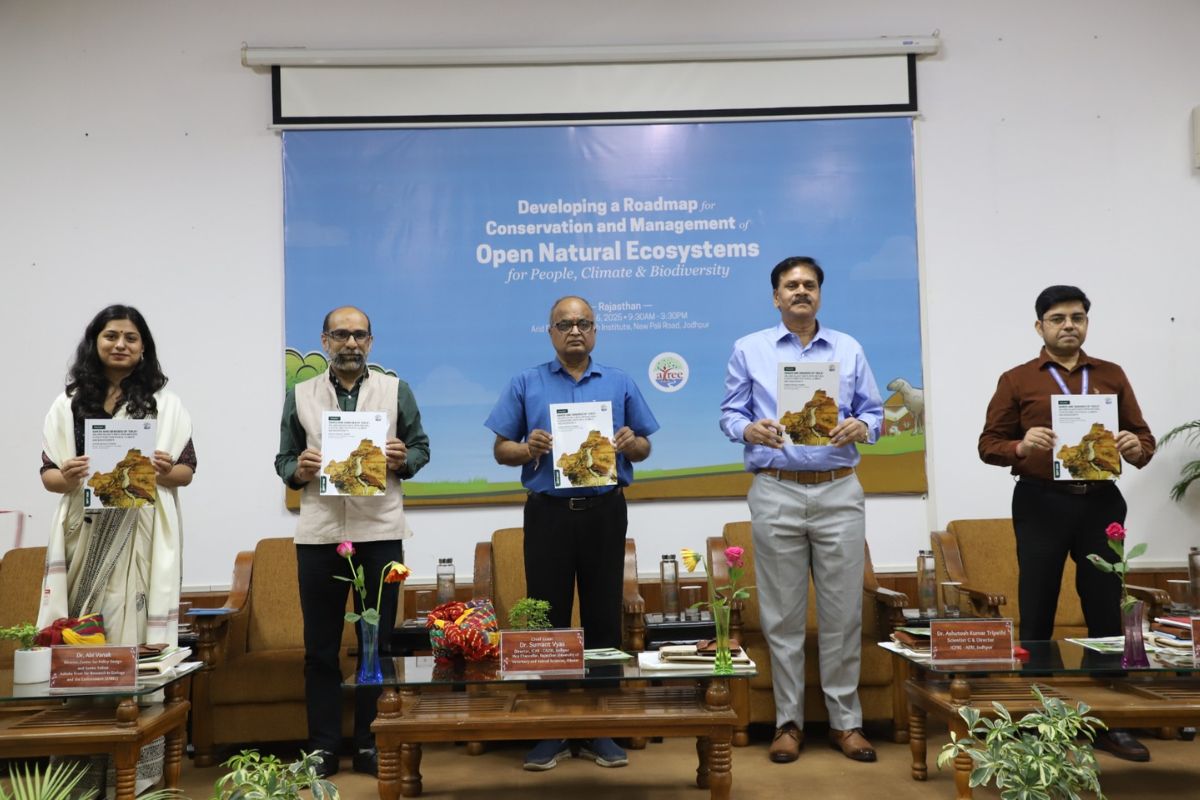
The Centre for Policy Design (CPD) at the Ashoka Trust for Research in Ecology and the Environment (ATREE), in partnership with the Indian Council of Forestry Research and Education’s Arid Forest Research Institute (ICFRE-AFRI), held a state-level consultation in Jodhpur to plan sustainable management of Rajasthan’s Open Natural Ecosystems (ONEs).
The consultation took place at the ICFRE-AFRI campus in Jodhpur. Participants included senior representatives from government institutes such as the Indian Council of Forestry Research and Education (ICFRE), Indian Council of Agricultural Research–Central Arid Zone Research Institute (ICAR-CAZRI), Rajasthan Forest Department, Jodhpur Division, and the Botanical Survey of India. Civil society organizations such as the Desert Resource Centre, Camel Charisma, Foundation for Ecological Security, Bombay Natural History Society (BNHS), as well as members of the “Oran Bachao” movement and local pastoralists attended.
At the consultation, CPD-ATREE released a policy brief titled “Sands and Grasses of ‘Gold’: Valuing Rajasthan’s Open Natural Ecosystems for People, Climate and Biodiversity.” According to the report, the brief details the ecological, economic, and cultural importance of Rajasthan’s deserts and grasslands. These include Orans and grazing lands, which are essential for fodder security, biodiversity, and climate adaptation.
Despite covering nearly 34% of Rajasthan, including grasslands, deserts, shrublands, and rocky outcrops, the largest proportion in India, ONEs remain under-acknowledged in current land-use and policy frameworks. As per the report, this neglect leaves them vulnerable to land conversion, degradation, and fragmented governance. Policies to protect ONEs could preserve biodiversity while supporting industries such as livestock, dairy, wool, meat, renewable energy, and tourism.
The report mentioned that Rajasthan’s deserts and grasslands sustain a vast livestock sector, making the state the second-highest milk producer in India and one of the largest wool producers. These areas also support meat production, renewable energy projects, and tourism. Additionally, Rajasthan is a key habitat for several endangered species, including the Great Indian Bustard, Indian Wolf, Blackbuck, and Chinkara.
Dr. Suman Vyas, Director of CAZRI and Chief Guest of the workshop, said in his keynote address that the Thar Desert is a progressive ecosystem. He added, “The damage caused to open ecosystems by economic activities can be mitigated only through the conservation and proper development of livestock, pastures, and Oran-Gauchar areas.”
Dr. Ashutosh Kumar Tripathi, Director of AFRI, said in his presidential address that cooperation, dialogue, and responsibility in the workshop will pave the path for sustainable development of open ecosystems.
Dr. Abi Tamin Vanak, Director of CPD-ATREE, said that Rajasthan’s open natural ecosystems are vital for livelihoods. She added that integrated efforts in biodiversity conservation, livelihood support, and capacity building can help mitigate climate change impacts.
Dr. Tarun Kant, Scientist-G and Program Coordinator, welcomed participants and emphasized that collective efforts from institutions and organizations can help achieve the goals for open ecosystems.
The technical session featured AFRI Scientist Bhavana Sharma and experts from various fields, including Dr. Chandan Singh (Botanical Survey of India), Dr. Sujit Narware (BNHS), Mohib Uddin (Wildlife Institute of India), Ilse Kohler-Rollefson (Camel Charisma Private Limited), Jugat Singh (Oran Bachao Andolan), Anshul Ojha (Desert Resource Centre), Sanjay Singh (ICFRE), and community representatives such as Moti Urmul and Dimple.
The speakers highlighted the need for cross-sectoral alignment between state and central agencies. According to the report, they stressed the importance of including ONEs in official records for improved management of semi-arid landscapes. The report mentioned that key priorities include co-developing a roadmap for the conservation and management of ONEs in Western Rajasthan.
The roadmap is expected to advance livelihoods, fodder security, biodiversity, climate resilience, and sustainable land use. According to the report, it will be guided by inclusive governance that combines scientific research and community participation.
The recommendations from the consultation aim to shape sustainable land use in Rajasthan while contributing to India’s broader climate and biodiversity commitments under Viksit Bharat. The report mentioned that strengthening governance in these landscapes will ensure Rajasthan’s deserts and grasslands remain a source of resilience and economic security for future generations.
The consultation marks a step toward recognizing the full value of Rajasthan’s open ecosystems. As per the report, it provides a platform for dialogue among policymakers, researchers, civil society, and local communities, creating pathways for coordinated and science-driven conservation efforts.
CPD-ATREE, established in 2019 with support from WestBridge Capital, facilitates dialogue between science, policy, and practice. The centre draws on ATREE’s expertise in conservation and sustainability to inform policy decisions. ATREE has worked for nearly three decades on issues including ecosystem restoration, forest governance, water management, invasive species, and biodiversity conservation, translating research into actionable policy interventions.
The consultation in Jodhpur reinforces the role of open natural ecosystems in supporting livelihoods, sustaining biodiversity, and enhancing climate resilience. According to the report, it sets the stage for a long-term strategy that balances ecological protection with economic development in Rajasthan.
Support us to keep independent environmental journalism alive in India.
Keep Reading
Small Wild Cats in Big Trouble: India’s First National Report Released
He Left the City to Farm, But Tigers Made the Fields His Biggest Risk
Stay connected with Ground Report for underreported environmental stories.
Follow us onX, Instagram, and Facebook; share your thoughts at greport2018@gmail.com; subscribe to our weekly newsletter for deep dives from the margins; join our WhatsApp community for real-time updates; and catch our video reports on YouTube.
Your support amplifies voices too often overlooked, thank you for being part of the movement.