On World Wetlands Day in February 2026, Bihar’s three wetlands—Gokul Water Reservoir (Buxar), Udaipur Lake (West Champaran), and Gogabeel Lake (Katihar)—received their official Ramsar certification at a ceremony in New Delhi.
A Ramsar site is a wetland designated under the Ramsar Convention for its international ecological importance, ensuring its conservation and sustainable use, particularly for biodiversity, water regulation, and livelihood support.
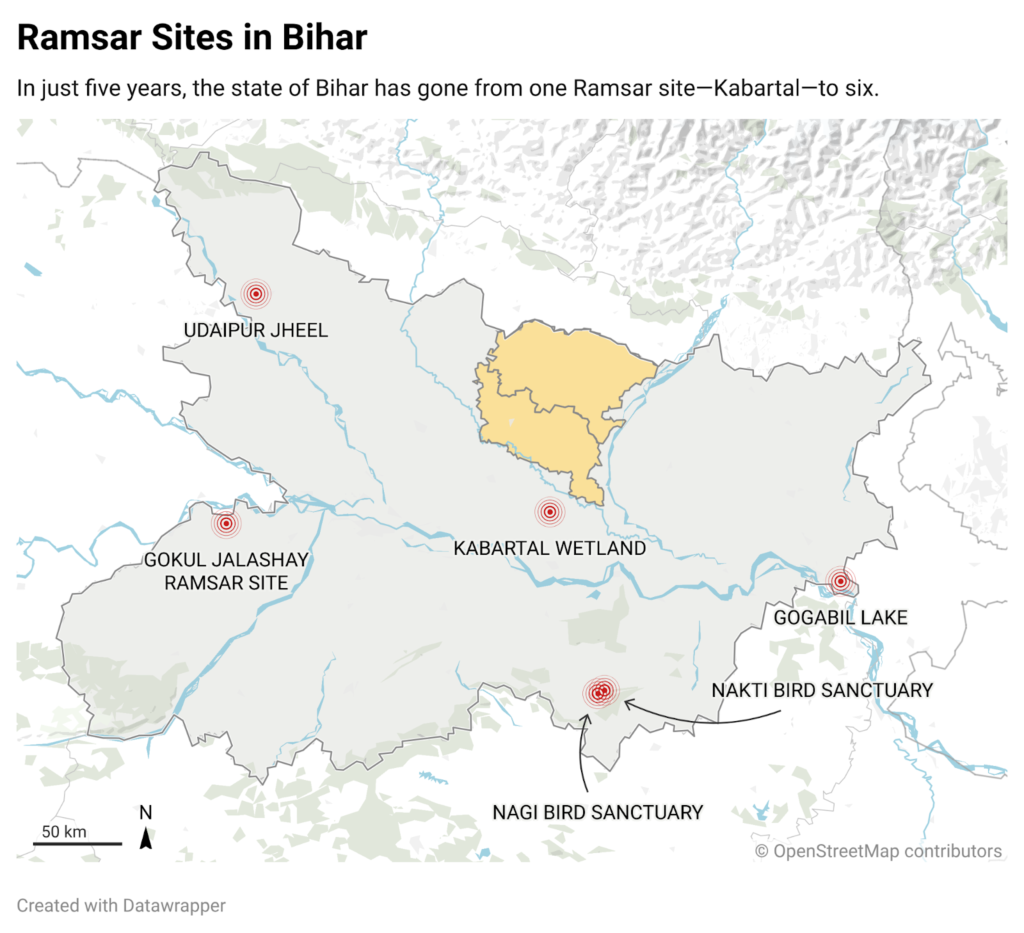
Bihar has 4,416 wetlands (> 2.25 ha) and 21,998 wetlands, including those smaller than 2.25 ha. The mentioned sites had already been added to the Ramsar list in 2025, but the certification marked their formal international recognition. Along with earlier inclusions such as Kabartal (2020) and Nagi and Nakti Bird Sanctuaries (2024). In just five years, the state of Bihar has gone from one Ramsar site to six. The jump has pushed Bihar into the top three Indian states in internationally recognized wetlands.
Many experts see the recent push around wetlands as a shift in how the state administration—working alongside the central government—views water and biodiversity conservation. The Ramsar designation has, in many ways, acted as a catalyst—bringing attention, resources, and a framework for action, like wetland authorities, conservation plans, and public messaging increasingly highlighting the ecological value of these landscapes. At the same time, the state has announced plans to develop tourism around its Ramsar sites, linking conservation with local livelihoods.
Yet, not everyone shares the same optimism. While institutional structures are now in place, implementation on the ground remains uneven. Key gaps persist, including incomplete demarcation, delayed management plans, and limited enforcement against encroachments and pollution. The question is whether the pace of action can match the scale of change the state is facing.
This urgency is hard to ignore. An assessment by the National Mission for Clean Ganga found that about 4,070 hectares of wetlands—representing a 4.1% decline—were lost to land-use change between 2008 and 2023. Without proper demarcations, many lakes and ponds are lost to the land mafia, an activist stated. And Bihar faces climate-linked water stress. Wetlands like Kabartal continues to face mounting anthropogenic pressures—from encroachment to water contamination. And others lack proper research and conservation plans. As an expert noted, designation is only a first step; the real test lies in whether conservation strategies translate into sustained, measurable change. And, in this article, we ask that question.
After Dr. Saroja Kumar Barik joined the Bihar government as a wetland expert, a project began to study the 133 identified wetlands, covering over 100 hectares. The intention was to gather evidence and initiate a conservation plan. The first step, as Barik explained, is legal notification; without it, even identifying ownership and enforcing protection becomes difficult, he said.
“Awareness has increased,” said Sunil Choudhary, who has worked extensively on wetland ecology and biodiversity in Bhagalpur. The state has begun generating ecological data, forming volunteer networks like “wetland mitras,” and expanding participation in exercises like the Asian Waterbird Census.
Kabartal, Asia’s largest oxbow lake, was notified as a Ramsar site in 2020. “If I write a story on Kabartal, I would call it a dying wetland,” Choudhary said. This is a well-researched site compared to other Ramsar sites.
Dr. Kirti Avishek, an associate professor at BIT Mesra, published a study in 2024 on the Kabartal wetland. The study finds that wetlands have shrunk between 1989 and 2023 due to agriculture and construction. While soil contains high mineral content and water quality remains within safe limits, declining vegetation and water cover are evident.
“TDS (total dissolved solids) was very high… if turbidity is high, the fishery sector will be hampered,” Avishek said. When asked whether conservation efforts had visibly improved after the research or Ramsar designation, “No… not at all,” Avishek said.
“There are multiple factors—the [Kabartal] lifeline and the sources from the Budhi Gandak River have already been choked,” Choudhary said. “Compared to that, other wetlands like Nagi are doing better—there is awareness, people’s participation, wetland mitras, and tourism has grown.”
Under a central scheme, funds are allocated to states to protect and restore wetlands—but the results are uneven. In Bihar, some sites like Nagi and Nakti have used these funds effectively, while others, such as Kabartal Wetland in Begusarai, have received ₹64.10 lakh but have not been used at all.
Barik acknowledges the state of wetlands and Ramsar sites. He said, “Through schemes like MGNREGA and Jal Jeevan Hariyali Mission, work is being done to remove water hyacinth and keep water bodies clean.”
There is more than enough reporting on the state of Kabartal, while the same can’t be said about the other Ramsar sites.
Wetland Health Cards
Wetland health cards are part of India’s official conservation framework, used to assess ecological condition and guide management actions, forming one pillar of a four-pronged approach that includes brief documents, Wetland Mitras, and integrated management plans.
The wetland portal has 71 health cards uploaded from Bihar. Out of the six Ramsar sites in Bihar, only two have health cards—Kabartal and Gogabeel on the portal. While the other two, Nagi and Nakti Bird Sanctuaries, have a health card tucked in the documents hyperlink on the state’s wetland authority website.
The Nagi and Nakti Bird Sanctuaries were designated as Ramsar sites in June 2024. But their wetland health cards were last updated on March 8, 2021. Needless to say, it is dated. Nagi and Nakti Sanctuary present a similarly positive ecological profile, also scoring around 0.91/1. Though neither had a finalized management plan or clearly demarcated wetland boundaries, highlighting governance as a key concern.
Kabartal Wetland faces serious hydrological challenges. The ratio of blocked or diverted inlets is very high (ranked “E”), indicating major disruption to natural water systems. A small portion (1–5%) of the wetland area has also been converted. On the governance front, mapping and notification are complete, and a management plan has been prepared and submitted. The data was collected in 2022 and updated on July 16, 2025.
In the case of Gogabeel, around 6–10% of the wetland has been converted to non-wetland use since 2000, and both inlets and outlets show signs of disruption, affecting water flow. Invasive plant species cover 11–20% of the area, indicating emerging ecological pressure. While bird populations appear stable or increasing and the wetland is officially notified, its management plan is still under preparation. The data for this assessment were collected in 2020 and entered on the Wetlands of India Portal on July 7, 2021.
The officials at the wetland authority in the state of Bihar stopped responding to Main Media’s request for comment on the matter.
Beyond Ramsar sites
Narayan Choudhary, who has spent over a decade fighting to protect ponds in the region through the Talab Bachao Abhiyan, describes a system where even court orders struggle to translate into action. “We have been filing petitions since 2013… but even basic demarcation of ponds hasn’t happened,” he said.
In Darbhanga, in one case involving Moin Pokhar, a wetland spread across about 100 acres has reportedly lost 15–20 acres to encroachment and illegal land transactions. The petition stated that municipal drains now carry untreated sewage into the lake, while solid waste dumping and weed overgrowth have degraded water quality to the point of ecological collapse. In the counter-affidavit in early 2026, the administration argues that it [Moin Pokhar] is legally private land, undermining the very basis of the legal case.
“Even ponds filled with water are being filled up and sold,” said Choudhary, who has been part of the legal battle over Moin Pokhar. “Darbhanga once had over 350 ponds. Now barely 150 remain.”
Choudhary said Bihar is increasingly bearing the brunt of climate change–induced stress on its water bodies. He pointed to a Dainik Bhaskar report describing a dispute among local officials over water as early as February. Apart from water recharge, the groundwater in parts of Bihar, shaped by the alluvial geology of the Ganga–Brahmaputra basin, often contains arsenic, making wetlands, which act as natural filters, even more critical.
Wetlands support rich biodiversity and provide essential services such as food, water, and raw materials, while also helping recharge groundwater, clean water, reduce floods, protect against storms, control erosion, store carbon, and regulate the climate. Main Media reported on how migratory birds are visiting Bihar less due to compromised ecosystems, particularly in Kabartal wetlands, among other impacts on wetlands.
So, what has Ramsar status changed for water bodies and wetlands in Bihar? “There is definitely a shift—wetlands are no longer seen as wastelands,” Sunil said. “Ramsar designation has brought attention. But after research must come implementation.”
In some ways, that is true. Almost everyone interviewed said this or a version of this. Ramsar designation has brought visibility and political attention, data generation and ecological monitoring, institutional frameworks (committees, authorities, and citizen networks), and expansion of identified wetlands. But it has not yet ensured key things like action against encroachment, restoration of water systems, protection of smaller wetlands, or stronger coordination between local authorities and legal mandates.
“Conservation plans were being made by external agencies sitting in Noida, without realizing the ground realities—what actually exists there, what the real issues are,” Sunil Choudhary said.
Policies are good. The problem is translating them on the ground.
This report has been published in collaboration with Main Media.
Support Us To Sustain Independent Environmental Journalism In India.
More Ground Reports
How Can Bhoj Wetland Address the Issue of Microplastics?
Sirpur Wetland: Illegal buildings razed, fight for STP removal continues
Stay Connected With Ground Report For Underreported Environmental Stories.
Support Us To Sustain Independent Environmental Journalism In India.