In Lasjan, on the outskirts of Srinagar, Muhammad Ashraf looks over his paddy field. The soil lies cracked under the Himalayan sun, and the canal that once brought Jhelum’s waters to his land is bone-dry. “There’s no water to sow rice this year,” he says. What should have been green fields thick with young shoots and ready for harvest in September is now barren land.
Ashraf’s story is no longer unusual. Across Kashmir’s valley, farmers face the same reality. Back-to-back droughts have become frequent, rainfall is in decline, and 2025–26 marked the seventh consecutive winter rainfall deficit, with the December 2025–February 2026 period recording a 65 per cent shortfall. But farmers in Kashmir also say it is not just the changing climate threatening their livelihoods. Rampant sand mining, often illegal, has gouged riverbeds so deep that water no longer flows into traditional canals, cutting off lifelines that once sustained their fields.
Rivers that no longer flow as they should
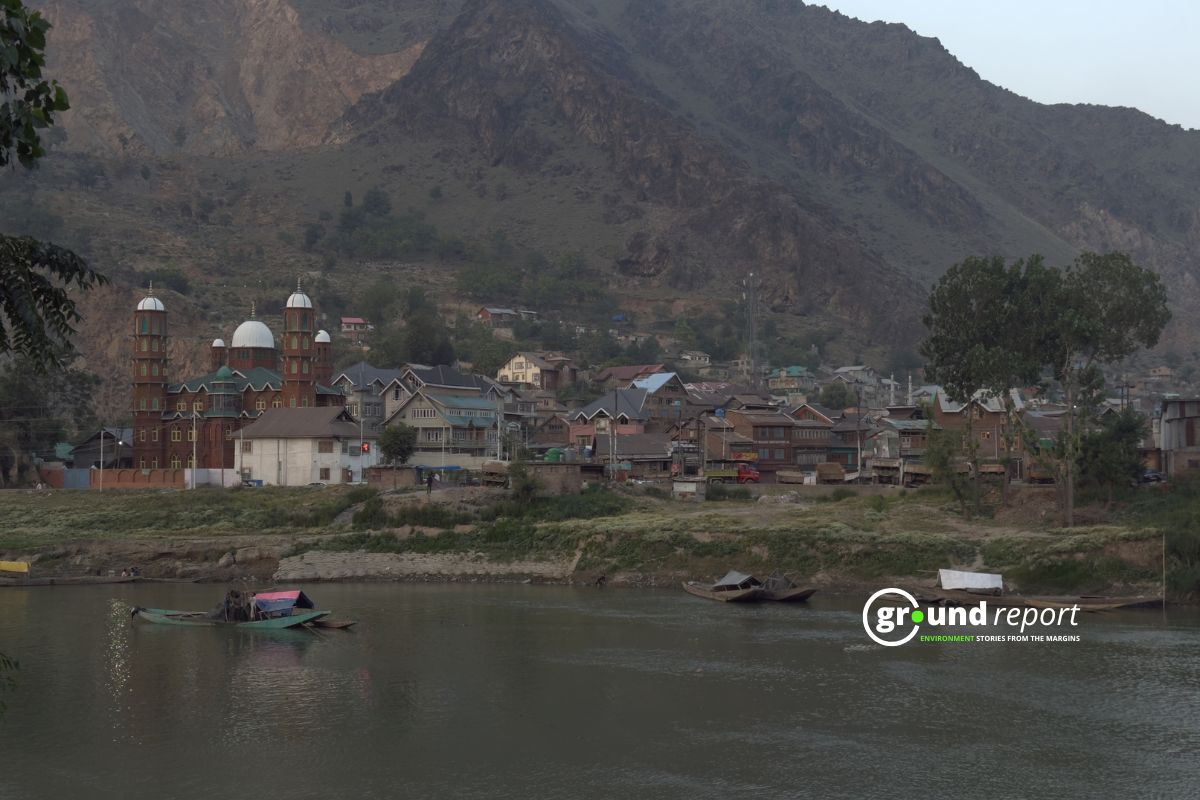
Kashmir, in India’s far north, is a fertile valley cradled by snow-capped mountains. The Jhelum and its tributaries: the Veshav, Sindh, Rambiara, and Romshi, are Kashmir’s arteries. They irrigate paddy fields, sustain apple orchards, and recharge countless springs, producing more than 2 million metric tonnes of apples and nearly half a million metric tonnes of rice each year. The apple industry alone generates about ₹8,000 crore annually, sustaining much of the region’s economy and livelihoods.
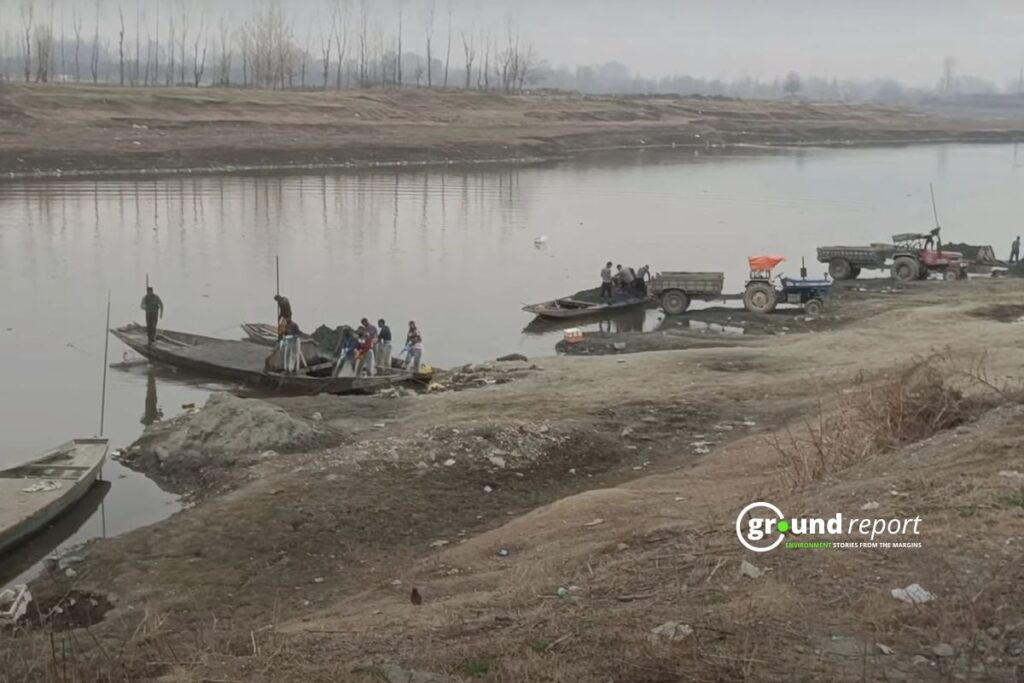
“They’ve dug the Jhelum so deep that water no longer reaches us through local canals like the Rambiara,” Muzaffar Rashid Bhat from Lethpora in Pulwama, a rice-growing hub told Ground Report.
The Pulwama district’s most recent Survey Report, available on its official website, dates back to 2018. It specifies where mining is permitted and under what limits. But farmers and activists say reality looks very different as unchecked extraction from rivers and streams is disrupting irrigation channels and lowering water availability for paddy.
Peer Manzoor, Executive Engineer of Irrigation in Pulwama, blamed climate change for reduced water discharge but conceded that sand mining in the Jhelum continues. “We don’t permit sand mining near the irrigation schemes,” he told Ground Report. Yet farmers in Pulwama and its neighbouring districts report ongoing sand mining that disrupts irrigation and farming.
Mining scale and its impact on water
Sand mining is not new to Kashmir, but its present scale is staggering. Across the world, up to 50 billion tonnes of sand and gravel are extracted annually, and Kashmir has become part of this surge. Here, operations often dig as deep as 50 feet ,far beyond the legal limit of three. The impact is devastating, in south Kashmir, aquifers have been pierced, springs have dried, and entire communities are losing dependable water.
Official data shows sand and other minor minerals extraction doubled from 4.74 lakh metric tonnes in 2021–22 to 11.42 lakh in 2022–23, driven by infrastructure projects like the Delhi–Katra motorway. In the Rambiara and Romshi sub-basins of south Kashmir, excavations have pierced shallow aquifers, lowering water tables and drying up springs and wells. Entire communities are losing access to reliable water.
A recent report also counted 453 stone and hot-wet mix plants and 113 licensed minor mineral units operating in the region. In Baramulla, a northern Kashmir district along the Jhelum river, a dozen of these operate within just one kilometre of the Lachipora Wildlife Sanctuary – home to the endangered markhor, Asiatic black bear, and other fragile Himalayan species. Studies confirm the consequences: noise, dust, and polluted runoff that alter soil pH, damage agriculture, and disrupt already stressed ecosystems.
Fisheries and farmers in same storm
The damage ripples beyond fields. The Veshav River, once famous for trout, now runs choked with silt and stone-crusher pollution. Breeding grounds vanish as sand and gravel are hauled away.
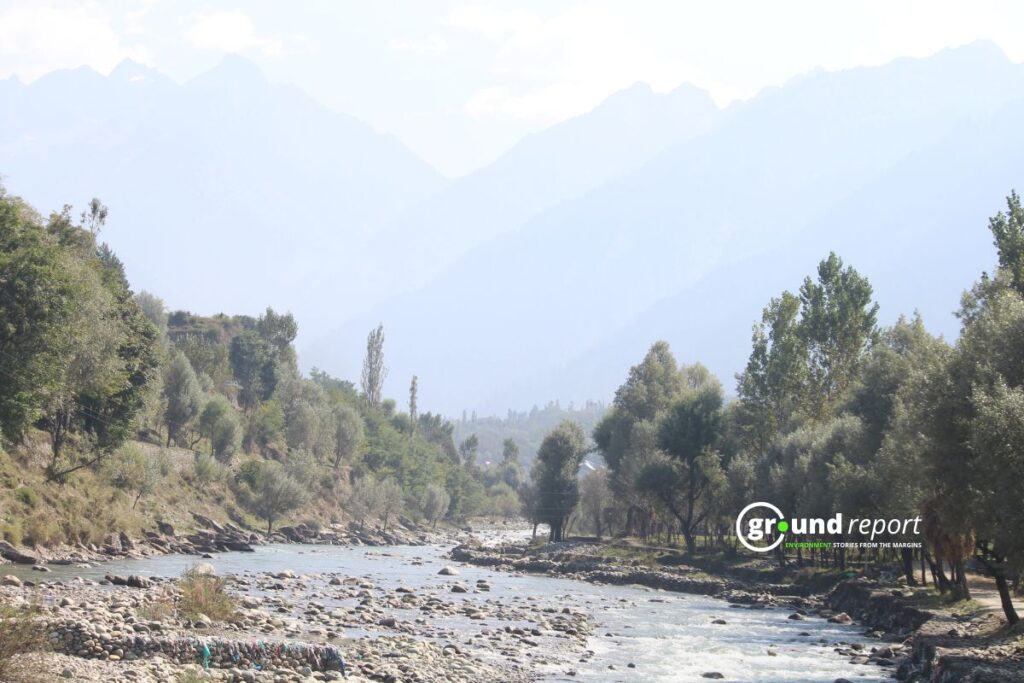
“Fish numbers are falling. You can’t recreate a river on a farm,” Zahoor Ahmad Shah, a veteran in Kashmir’s fisheries sector told Ground Report. Over 93,000 people depend on fisheries and produce 20,000 tons annually. The Fisheries Department operates 534 trout units and provides support to over 17,000 families. Yet trout stocks are shrinking. As Dr Sarah Qazi serves as hydrogeologist and the only female faculty member at the Department of Earth Sciences warns, “If we don’t protect recharge zones, we’re leaving a broken system for the next generation.” Farmers and fishers, though in different trades, are bound by the same threat—vanishing water.
Governance gaps: Rules on paper, rivers on sale
In 2016, the High Court banned mining deeper than three metres or closer than 25 metres from riverbanks. On paper, the penalties are strict. The law requires officials to seize minerals along with the vehicles and equipment used. Offenders can only reclaim them after paying the mineral’s cost, royalty charges, and a minimum fine of ₹10,000.
In June 2024, the government reported 6,219 seizures and penalties worth ₹16.79 crore. But on the ground, illegal mining shows no signs of slowing. The National Green Tribunal fined the J&K government ₹1 crore in 2022 for failing to check violations.
On March 17, 2026, government data shows a strong enforcement push, with over 13,600 vehicles seized and 446 FIRs registered in Jammu and Kashmir over the past two years, up to December 2025. Districts like Kupwara, Budgam, and Baramulla have emerged as key hotspots, pointing to the scale of illegal mining despite ongoing crackdowns.
Korel village, home to about 1,100 people across 253 households, lies just a few kilometres from the Vishaw river, a tributary of the Jhelum. By day, it looks like any other quiet settlement in Kashmir. But at night, the riverbed turns into a mining ground. Heavy machinery digs deep into the earth, flouting rules and pushing the village into the shadow of constant activity.
Even government officials admit violations are rampant but cite “pressure from higher authorities,” as a reason for weak enforcement. “It’s willful vandalism,” says a senior officer from the Geology and Mining Department, requesting anonymity.
Livelihoods threatened by mining ban
The mining ban has also created tension. At Ganderbal district in Central Kashmir, women recently staged protests when authorities halted sand extraction on the Sindh River. “We don’t want charity. We’ve taken loans, bought tippers, and worked hard for years. Now they’ve stopped everything without giving us options. Let us work and feed our children,” says Saleema, a mother of three. Many families who invested in vehicles and equipment now struggle to repay debts without steady earnings. Authorities met the protesters and promised to raise their concerns with higher officials.
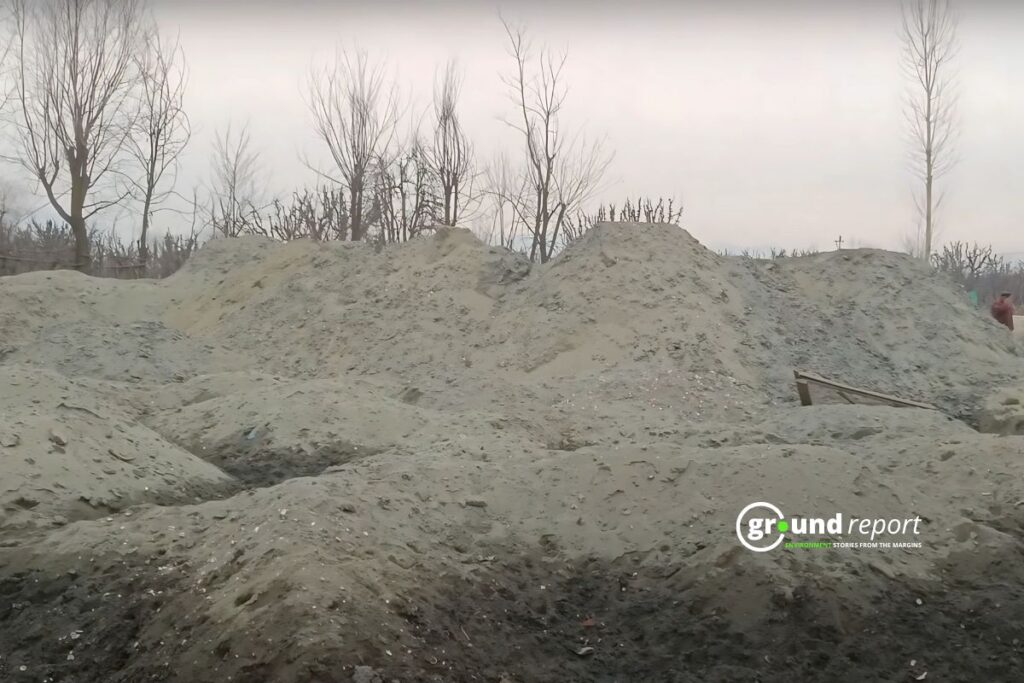
For families who rely on manual mining, the trade is survival. But while it provides short-term income, it risks undermining the far larger water-dependent economy of agriculture and orchards. Springs once used for irrigation, like Arbal Nag and Bulbul Nag, are already drying. Apples and paddy worth thousands of crores may be the ultimate cost.
Kashmir’s mining revenue touched ₹181.04 crore over the past five years, but the environmental costs may prove far greater. While extraction brings short-term income, it threatens agriculture worth thousands of crores each year. The apple industry alone contributes over ₹8,000 crore annually, but orchards depend on reliable water supplies that mining is drying up. Various reports link riverbed mining to drying springs such as Arbal Nag and Bulbul Nag, which once irrigated farmland and orchards
The Government of India’s Sustainable Sand Mining Management Guidelines (2016) recommend restricting riverbed mining to one metre in groundwater recharge areas, along with rainwater harvesting, check dams, and afforestation programmes to restore water systems. Without action, Kashmir risks losing both its water resources and the communities tied to them. Trout stocks are already under pressure, and further damage could imperil not just the rivers, but the livelihoods and food security they support.
This story is produced as part of the India Water Portal Regional Story Fellowship 2025.
Support Us To Sustain Independent Environmental Journalism In India.
More Ground Reports
Panna: Villagers Protest Irrigation Projects, Demand Documents, and Transparency
Fulkai Maai Demands the Return of Crèches for Malnourished Korku Children
Stay Connected With Ground Report For Underreported Environmental Stories.
Support Us To Sustain Independent Environmental Journalism In India.