
The world continued to experience record-breaking heat in September 2025. According to new data from the Copernicus Climate Change Service (C3S), the month was the third warmest September ever recorded, following September 2023 and September 2024.
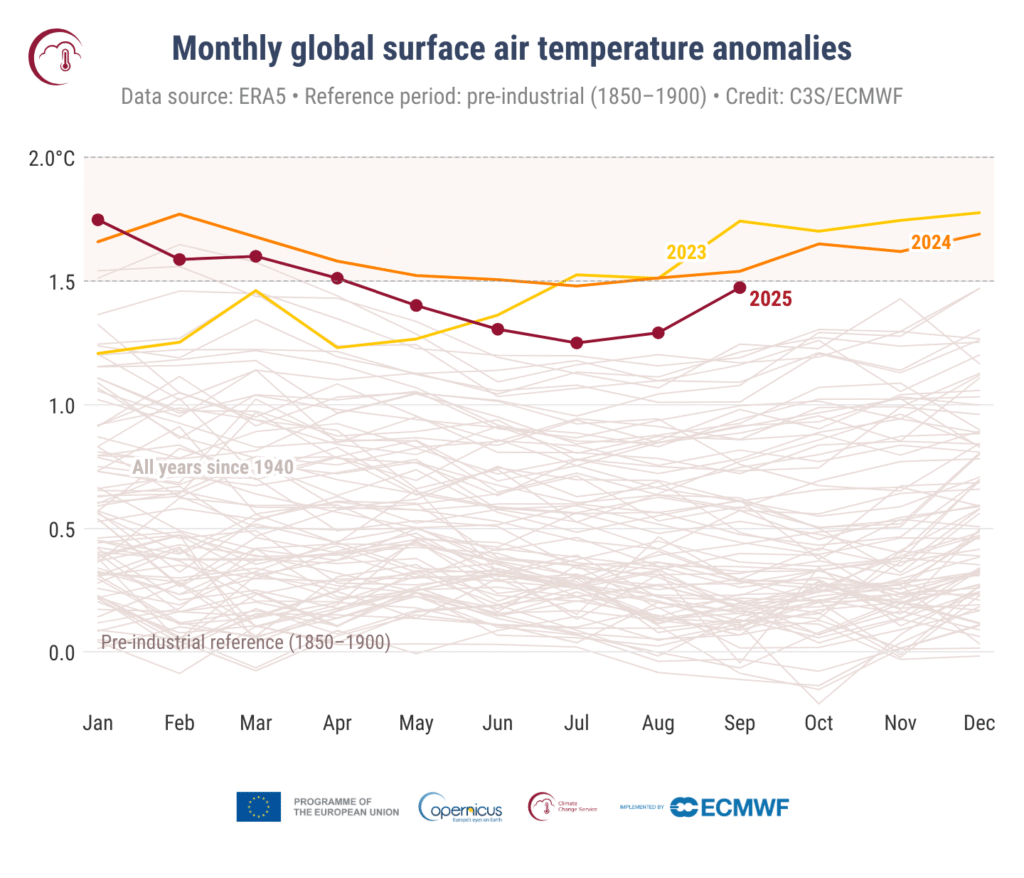
The global average surface air temperature reached 16.11°C, which is 1.47°C above pre-industrial levels and 0.66°C higher than the 1991–2020 average. The 12-month period from October 2024 to September 2025 averaged 1.51°C above pre-industrial temperatures, marking another year of persistent global warmth.
Ocean temperatures stay high
The world’s oceans remained unusually warm. The global average sea surface temperature for September was 20.72°C, the third highest for that month on record. It was only 0.20°C cooler than September 2023, the warmest ever.
The North Pacific Ocean showed the most extreme heat, with some areas hitting record highs. The Norwegian Sea, Mediterranean Sea, and Kara Sea were also warmer than average. In the Mediterranean, the western and central regions saw the sharpest rise.
According to Samantha Burgess, Deputy Director of C3S, “The global temperature in September 2025 was the third warmest on record, nearly as high as in September 2024, less than a tenth of a degree cooler. A year on, the global temperature context remains much the same, with persistently high land and sea surface temperatures reflecting the continuing influence of greenhouse gas accumulation in the atmosphere.”
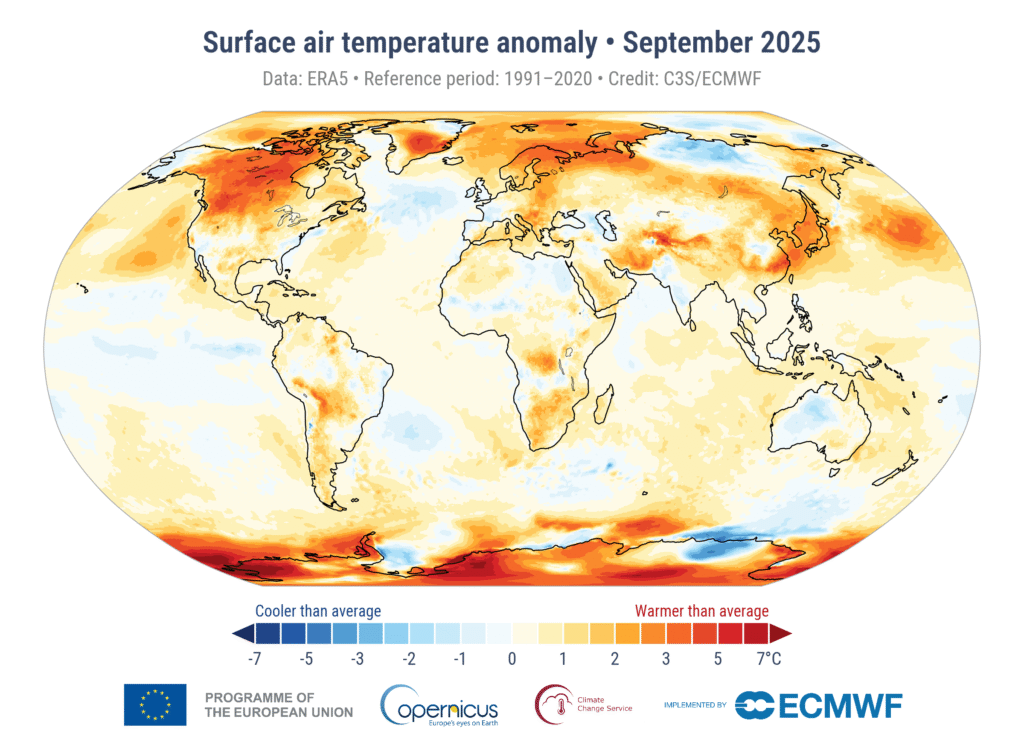
Europe experienced its fifth warmest September on record, with an average land temperature of 15.95°C, which is 1.23°C above the 1991–2020 average. The largest temperature increases were observed over Fennoscandia and eastern Europe, while western Europe recorded slightly cooler but still near-average conditions.
Outside Europe, higher-than-average temperatures appeared across Canada, Greenland, Siberia, and Antarctica. Cooler conditions were limited to parts of western Australia, northern central Siberia, and eastern Antarctica.
Heavy rains and floods
The combination of a warm atmosphere and ocean led to intense rainfall and flooding across many regions.
In Europe, northwestern and central areas, including Finland, Scandinavia, Italy, Croatia, and eastern Spain, were wetter than average. Floods affected some of these regions, disrupting transport and damaging infrastructure.
Similar patterns were seen globally. Parts of the United States, Alaska, Mexico, Brazil, Argentina, Chile, Pakistan, and India experienced above-average rainfall. The Horn of Africa and southern Arabian Peninsula also faced heavier rains.
C3S reports link many of these rainfall events to the interaction between warm sea surface temperatures and tropical cyclones moving across the Atlantic and Pacific basins.
In the Arctic, the daily sea ice extent reached its 14th-lowest annual minimum in the satellite record, about 12 percent below average. While not a record low, it remains part of a long-term downward trend.
In the Antarctic, sea ice reached its third-lowest annual maximum, with the monthly extent 5 percent below average. The Bellingshausen Sea and Indian Ocean sector showed the most pronounced losses, while some regions maintained near-average levels.
Persistent global warming
The temperature records from 2023 to 2025 reflect a continuing global warming pattern. Every month since January 2025 has ranked among the top three warmest for that month on record.
January 2025 was the warmest ever recorded. February was the third warmest. March to May ranked second warmest, and June to September were all the third warmest on record.
Scientists say these consistent high rankings show that human-induced greenhouse gas emissions are now the dominant factor influencing global temperatures, surpassing natural climate cycles such as the El Niño–Southern Oscillation (ENSO).
The years 2023 and 2024 were marked by one of the strongest El Niño events on record, typically linked to warmer global conditions. A brief La Niña phase emerged in early 2025, which usually brings cooler global averages. Yet, temperatures remained close to record highs.
The continued warming affects ecosystems, agriculture, and human health. Prolonged heat and changing rainfall patterns have strained water resources and caused crop losses in several regions.
In Europe, flash floods in parts of Italy and Croatia displaced hundreds of residents. In South America, heavy rains in southern Brazil disrupted harvests. Across Asia, Pakistan and northwestern India saw recurring floods during the monsoon season.
The September 2025 update continues to show the same trend seen over the past decade: steady global warming with intensifying regional weather extremes.
Support us to keep independent environmental journalism alive in India.
Keep Reading
Highway Halt Puts Kashmir’s Fruit Economy at Risk
MP brings back Bhavantar as farmers lose soybean harvests
Stay connected with Ground Report for underreported environmental stories.
Follow us onX, Instagram, and Facebook; share your thoughts at greport2018@gmail.com; subscribe to our weekly newsletter for deep dives from the margins; join our WhatsApp community for real-time updates; and catch our video reports on YouTube.
Your support amplifies voices too often overlooked, thank you for being part of the movement.