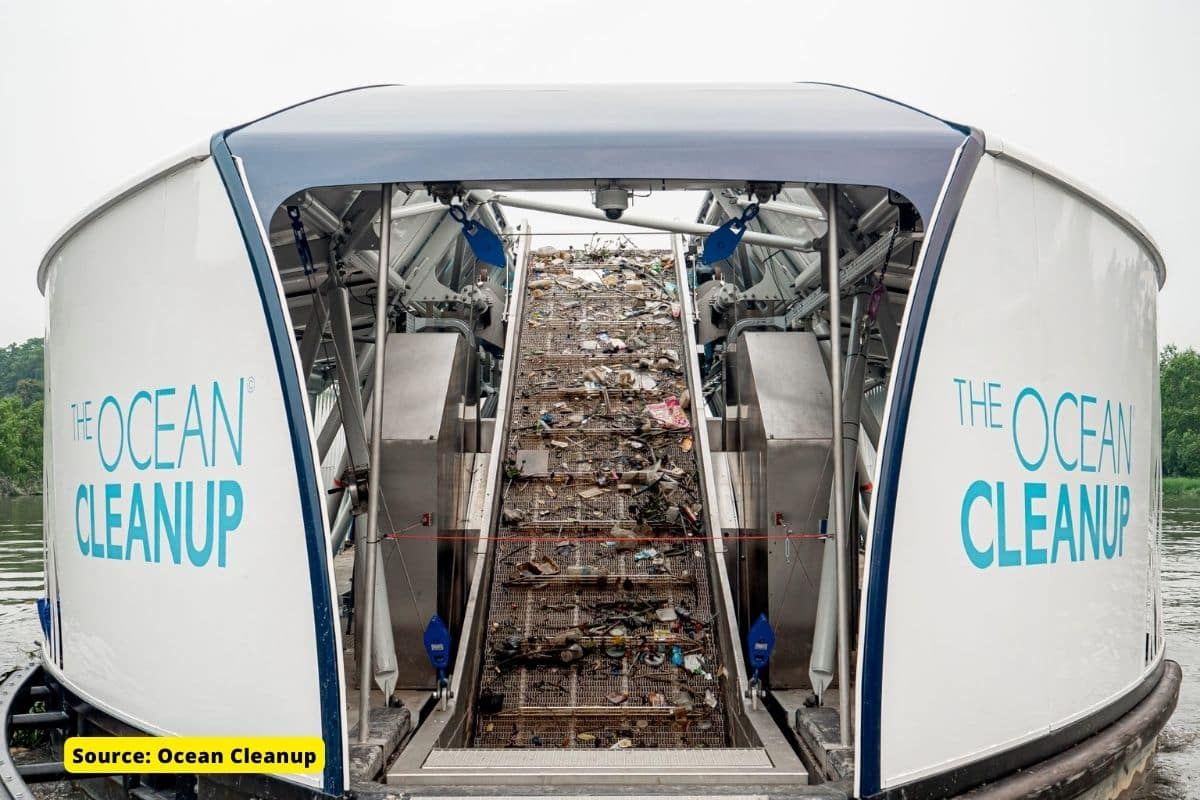
Los Angeles County inaugurated a 73-foot floating barge in early October that automatically collects debris from the shoreline before it floats out into the ocean. The vessel is called Trash Interceptor 007 and has been developed by The Ocean Cleanup.
The two-year pilot project is the result of a partnership between Los Angeles County and Ocean Cleanup to address the problem of stormwater pollution in Ballona Creek. But the project’s proponents hope it will pave the way for the implementation of a scalable solution around the world.
Trash Interceptor 007 is a 73-foot-long catamaran with a removable barge that holds six collection boxes for a combined storage capacity of 1,750 cubic feet. Its automated trash rack and conveyor belt system work as smoothly and quietly as a regular appliance for an environmentally friendly and efficient solution to in-water trash collection.
Each year, between 30 and 60 tons of trash enter Ballona Creek, washed away by runoff from city streets. The county has invested in several ways to protect local rivers, lakes, and oceans from pollution, including banning single-use plastics, installing stormwater filters and diverters, and culturally competent public outreach efforts, including trips to the garbage campaign, in several languages.
“Protecting the region’s waterways from contamination is a responsibility we share with the public and the cities of the region,” he said. Los Angeles County Public Works Director Mark Petrella, PE “Interceptor 007 is the latest innovation put in place by the county and its partner, The Ocean Cleanup, to protect our public health, beautiful coastline and marine environments.”
How does it work
The Interceptor is designed like a catamaran with a low center of gravity, so it is stable and will stand upright. The vessel is moored to the riverbed while floating booms funnel debris towards the opening of the collection system.
River currents move the waste onto a conveyor belt, which lifts it out of the water and delivers it to an automated ferry. The ferry uses sensors to evenly distribute waste across the six dumpsters, which are located on a separate barge.
The Interceptor is solar-powered with lithium-ion batteries, so the sensors, lights, conveyor belt, shuttle, and data transmission will work day and night and through the winter. You also have a computer connected to the Internet that monitors system performance, power usage, and component health.
When the dumpsters are almost full, the Interceptor sends a text message to local operators to pick up the waste. The barge is brought to shore and the garbage containers are emptied.
The Interceptor can remove 50,000 kilograms of garbage per day. The Ocean Cleanup says its team is working with partners to recycle plastic into durable goods.
During the live stream, Slat held up a part of the Interceptor’s “fender” and said it’s one of his favourite things about the invention.
“We had to do it with plastic, so we thought about doing it with plastic that we’ve taken from the ocean,” Slat said. “I think that’s just a full circle, so that’s cool.”
Also Read
- Sarbal Village: A hamlet in Kashmir waiting for development
- Farmers in MP face crop failure every year due to climate change
- Climate Change: Kishanganga Dam causes water concerns
Follow Ground Report for Climate Change and Under-Reported issues in India. Connect with us on Facebook, Twitter, Koo App, Instagram, Whatsapp and YouTube. Write us on GReport2018@gmail.com